Davenport IA Epoxy Flooring has more than 20 years behind it, and a steady part of our epoxy-flooring in Bettendorf work comes from clinics planning a remodel rather than homeowners planning a garage. A dental office asks more of a floor than most buildings do, because the room with the patient chair, the room with the autoclave and the waiting room each need something different underfoot.
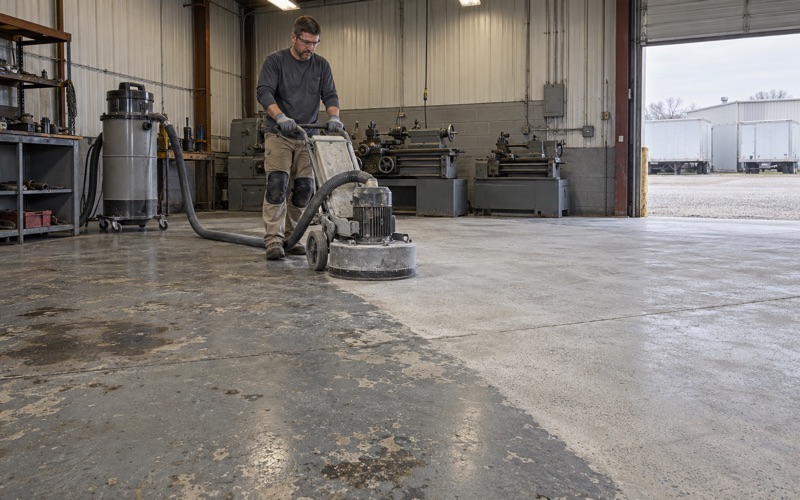
Our proposals are written so a practice manager can check them later. The slab is opened with a diamond grinder or a shot blaster, never an acid etch, and the proposal states the surface profile we are grinding to. A moisture test sits in the scope before the price is final, and the quote names the product line, the number of coats and the finished thickness.
We hold no license or certification to advertise, and we do not dress a coating up as a regulatory requirement. What we bring to a clinic is a plan for which rooms get a hard, cleanable floor, which system goes down in each one, and how the work fits around the people in the chairs.
A Dental Remodel on Utica Ridge Road and the CDC Carpet Guidance
Bettendorf is a city of about 39,000 people in Scott County, Iowa, one of the five cities that make up the Quad Cities and the next city east of Davenport along the Mississippi River. Its dental offices are not static buildings. They get rebuilt, and each rebuild reopens the floor question.
A rebuild on Utica Ridge Road
Kimball & Beecher Family Dentistry, at 3520 Utica Ridge Road in Bettendorf, went through a full rebuild of its office. The Quad Cities Chamber reported that construction began in March 2024 and would be fully completed in June 2025, and the ribbon cutting for the completely remodeled office was held on July 31, 2025. We have no connection to that practice, and nothing published about the project describes its rooms or its floors, so we draw no conclusion about what is under its chairs.
What the project does show is the timing. A practice on Utica Ridge Road or Middle Road does not replace its floors every few years, so the remodel is usually the one chance in a long stretch to decide, room by room, what each floor should be.
What the 2003 CDC guideline says
The 2003 CDC guideline, Guidelines for Infection Control in Dental Health-Care Settings, includes recommendation VII.E.1: avoid using carpeting and cloth-upholstered furnishings in dental operatories, laboratories, and instrument processing areas. The reasoning in the text is direct. Carpet is more difficult to clean than nonporous hard-surface flooring, and it cannot be reliably disinfected.
The same guideline says floors should be cleaned regularly and spills cleaned up promptly, and that housekeeping surfaces such as floors mostly need only detergent and water. That is a useful frame for a floor decision, because it describes how the floor will actually be treated day to day.
Category II is a suggestion, not a rule
VII.E.1 carries a Category II rating, which makes it a suggestion rather than a regulation. We have not found an Iowa rule that requires a coated floor in a dental office, and we never tell a practice that CDC, the state or anyone else requires epoxy. We cite the guideline because it is the clearest published reasoning for keeping carpet out of clinical rooms, and the practice decides from there.
Looking for epoxy-flooring closer to Moline? See Epoxy-Flooring in Moline.
Operatories, the Lab and the Sterilization Room Are Different Rooms
The guideline names three kinds of space, and in a real office they are three different floors. We walk the plan with the practice and mark each room as clinical or front office before any product is named.
Dental operatories
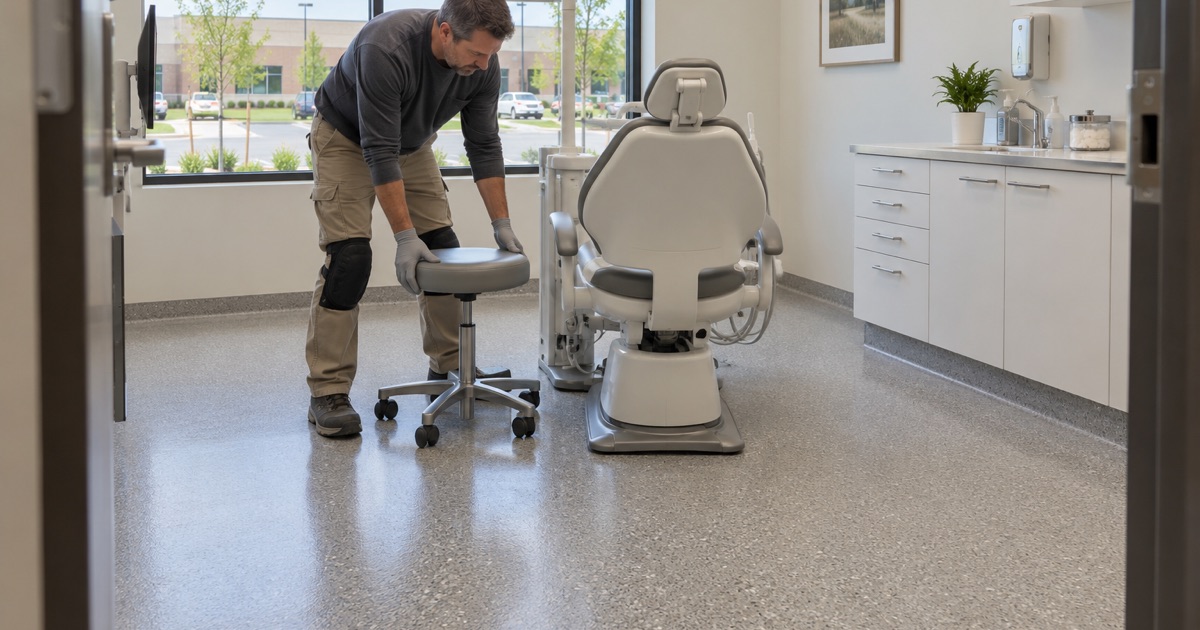
An operatory floor carries a heavy chair on a mounting plate, a delivery unit, rolling stools and carts that cross the same few feet hundreds of times a week. The chair base and any floor box for utilities have to be coordinated with the coating so the system terminates cleanly around them instead of being cut in afterward.
We usually suggest a 100% solids epoxy body coat with a polyaspartic or urethane topcoat in these rooms, with a fine texture that still mops easily. Stool casters and cart wheels wear a path, so the topcoat choice is about abrasion as much as appearance.
The laboratory
A practice lab sees a different kind of mess. Gypsum and plaster dust from model work, slurry from a model trimmer and grit from a crown mill settle on the floor and get tracked out of the room. A smooth, hard floor lets that be swept and wet-mopped rather than ground into a fiber surface.
Instrument processing areas
The sterilization room is the wettest room in most offices. Sinks, ultrasonic cleaners and sterilizers keep water near the floor, and staff move quickly between the dirty side and the clean side. Here we look hard at slip resistance near the sink and at where the floor meets the wall, and a coved base is one option a practice can weigh for that junction.
The front office can stay as it is
Reception, consultation rooms and business offices are outside the three spaces the guideline names. Plenty of practices keep carpet or another finish there, and we would rather quote three rooms correctly than coat a building that does not need it.
A Floor That Takes the Practice’s Own Cleaners
A clinical floor is judged by how it holds up to the products the staff already use. Choosing a coating without knowing those products is guessing.
Start with the cleaning products
We ask the practice for the detergents and disinfectants its team uses on floors and check them against the coating manufacturer’s chemical resistance data before we name a system. If a topcoat dulls or softens under a product the office will not give up, that topcoat is the wrong choice for that room, however good it looks on a sample board.
Topcoats and texture
Polyaspartic and polyurea topcoats, urethane cement in rooms with heavier water and a 100% solids epoxy base are the systems we compare for clinic work. Texture is set by the room: a quartz aggregate broadcast near a sterilization sink, a lighter grit in an operatory where a mop has to glide.
We also watch for amine blush on epoxy layers that cure in cool, damp air, because a blushed coat that is topcoated anyway can fail to bond.
The slab under the old floor
When carpet, vinyl tile or an old coating comes up during a remodel, it leaves adhesive and patches behind. We grind those off rather than coat over them, and we map cracks, spalls and old patches before quoting, saying plainly when a section needs repair first.
Moisture is checked before the price is final, with ASTM F2170 in-situ relative humidity probes or ASTM F1869 calcium chloride testing depending on the slab. Moisture vapor transmission and hydrostatic pressure are the first exclusions we explain in any coating warranty, and we name them before the job is sold, not after a blister appears.
Working Around a Schedule of Patients
A dental office earns its income one appointment at a time, so the floor plan has to be a schedule plan as well. Nothing published tells us how any particular Bettendorf practice handled its own remodel, so we plan each office from its own calendar.
Phasing room by room
Operatories can often be taken out of service a few at a time while the rest keep seeing patients. The sterilization room is harder, because every clinical room depends on it, and that room is usually best done over a weekend or a closed stretch the practice chooses. We lay out the sequence in writing so the front desk can book around it.
Dust, odor and cure time
Grinding dust is pulled into a vacuum at the machine rather than swept or rinsed toward a drain, which matters in a building with open instrument storage down the hall. Low-odor products are available as a comfort choice for staff and neighboring tenants. Iowa has no state VOC rule for floor coatings; the federal 40 CFR 59 Subpart D rule binds the manufacturers, and we do not sell low odor as an Iowa legal requirement.
Cure timing follows the slab temperature and the dew point spread at the surface rather than the calendar. A room that has to reopen at 7:00 a.m. on a Monday gets a system and a start time chosen around that hour.
Which city signs off
Building work in Bettendorf answers to the City of Bettendorf as the building authority. One detail catches people: Riverdale is a separate city enclosed by Bettendorf, and a Bettendorf mailing address can sit inside Riverdale, so we confirm which city the building is actually in before anything is filed.
On commercial work we carry the certificate of insurance a permit office asks for. Iowa contractor registration under Iowa Code chapter 91C is a registration, not a license, and we explain that difference and any city requirements to a practice rather than claim a credential.
- 20+ Years in Business
- Moisture Tested Before Pricing
- Free Written Estimates