Davenport IA Epoxy Flooring has spent more than 20 years putting down epoxy flooring in Camanche shops, garages and plant buildings, and on an older industrial slab the first thing we study is the crack pattern. A floor coating can cover a lot of ordinary wear, but it cannot fix concrete that is still moving from the inside. When we walk a slab someone else poured decades ago, we map every crack, spall and old coating before a number goes on paper.
That walk-through is the start of the quote, not a courtesy. If what we see points to a problem in the concrete itself, we say so plainly and tell the owner the slab needs a diagnosis, a repair or a replacement before it should be coated. Selling a coat over a floor that will push it off is the most expensive mistake this kind of job can make.
When the slab does check out, the proposal reads like a specification. It names the product line, the number of coats, the finished thickness and the surface profile we will grind to, so the finished floor can be measured against the paper after we leave.
A Pipe Plant Becomes a Steel Shop, and the Slab Comes With It
From welded pipe to structural steel
Camanche is a Clinton County city on the Mississippi River, and its Seventh Avenue industrial corridor shows how often a plant floor outlives its first owner. The building at 2011 Seventh Avenue was the TMK IPSCO plant, which in 2017 planned to reopen and make welded pipe for oil and natural gas production and transmission. By 2019, notice had gone out that 101 of its 119 plant workers would be laid off.
In 2023 Merrill Steel, a third-generation family business supplying complex structural steel, announced it would expand fabrication into Camanche by purchasing and redeveloping an existing facility where it had been leasing space. The state economic development board put the capital investment at 18.3 million dollars. A grand opening followed that November, in a building that had been used for painting, fireproofing and en-masse steel storage.
An inherited floor has a history nobody handed over
Any owner who takes over an existing building also takes over its concrete, with whatever mix, aggregate and years of service went into it. We have no information about the condition of the slab on Seventh Avenue, and nothing here suggests a problem with it. The point is a general one: a slab you bought rather than poured comes without the records that would tell you how it was made.
That matters because a coating depends entirely on the concrete under it. A resin film is only as strong as the top of the slab it grips, and it has no way to restrain movement coming from below. When a floor’s past is unknown, the honest approach is to read the surface carefully before deciding what goes on top of it.
Looking for epoxy-flooring closer to Geneseo? See Geneseo Epoxy-Flooring.
Map Cracking and the Reaction That Can Cause It
What map cracking looks like
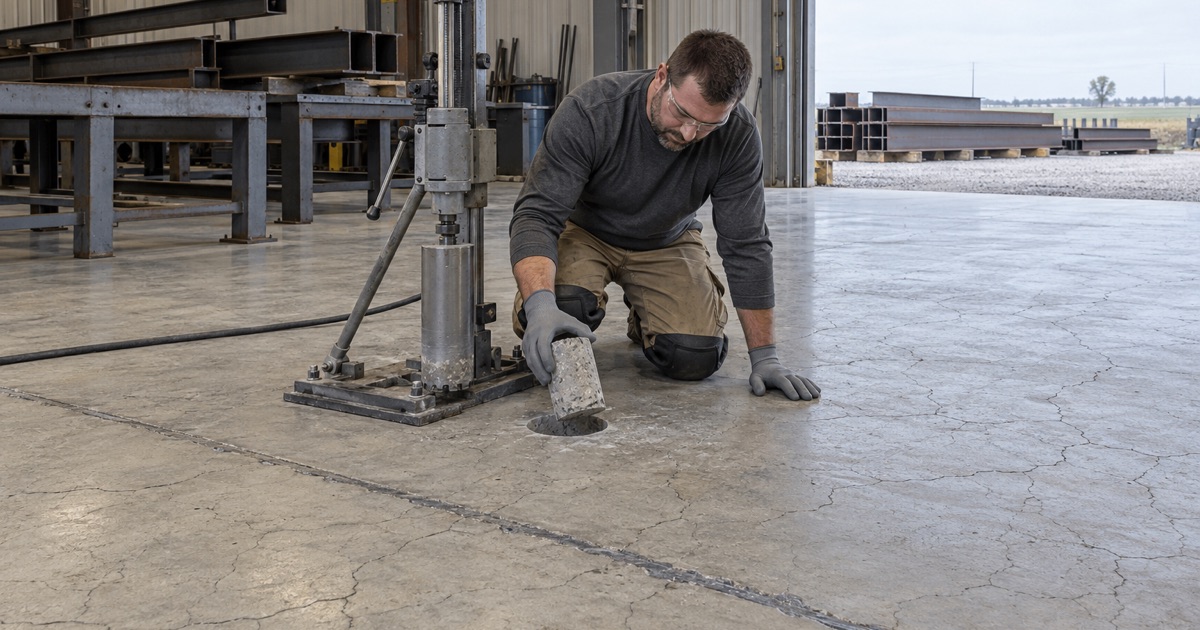
Map cracking is a network of fine, irregular cracks that join into a pattern resembling a road map or dried mud. It does not follow saw cuts or the edges of a pour the way ordinary shrinkage and control-joint cracks usually do. On an older industrial slab, it is one of the patterns that makes us stop and ask what is driving it.
Alkali-silica reaction in plain terms
One known cause of map cracking is alkali-silica reaction, usually shortened to ASR. Certain reactive aggregate contains silica that reacts with alkalis in the cement paste, forming a gel that takes on moisture and swells. The swelling is slow, it happens inside the concrete, and it can continue for years after the slab was placed.
Because the reaction is chemical rather than surface wear, grinding the top and rolling on resin does nothing to stop it. A crack pattern that looks cosmetic may be the visible edge of a slab that is still expanding underneath.
Not every map pattern is ASR
Other causes can leave a similar surface pattern, and we do not treat a photograph of cracks as a verdict. That is exactly why a crack map is a question for us rather than an answer. Telling the difference takes laboratory examination of the concrete itself, which is work for a design professional, not a flooring crew.
What our crack map records
When we map a slab, we sketch where each crack runs, whether it follows a joint or wanders across a panel, and whether its edges are raised, stained or crumbling. We note spalls, patched areas and any old coating that has lifted or bubbled. That sheet goes to the owner with the quote, so whoever examines the concrete next starts from what we saw rather than from memory.
A map pattern confined to one bay of a building tells a different story from one that runs across the whole floor. Recording the extent is part of the job, because it shapes how much of a slab a design professional may want to look at closely.
Why One Coating Maker Says Do Not Proceed
The data sheet in its own words
Coating manufacturers put their limits in writing, and one of the clearest on this subject is the product data sheet for Sikafloor-264, an epoxy floor coating. Its limitations section says not to apply the product to concrete containing aggregates susceptible to alkali-silica reaction, because of the risk of natural alkali redistribution below the coating after application. It then says that if the substrate has or is suspected to have ASR present, do not proceed, and consult with a design professional prior to use.
Why sealing the top changes the slab underneath
A dense resin film changes how moisture and dissolved alkalis behave near the top of a slab. The maker’s concern is that alkalis can gather beneath the film, so a floor that was reacting quietly may keep reacting right where the coating is bonded. The coating then takes the blame for damage it did not start.
The same sheet asks for concrete that is clean and sound, prepared by mechanical means to a profile of ICRI CSP 3 to 4, with compressive strength of at least 3,625 psi at 28 days. Sound is the word that matters there. A slab that may still be reacting is not one anybody can call sound by looking at it.
How that shapes our quote
We open every slab with a diamond grinder or a shot blaster rather than an acid etch, and the target profile is written into the proposal. On a floor showing map cracking, the grinder waits until the cause is known. If the owner’s design professional clears the slab, we proceed, and if not, we would rather walk away than coat a floor the manufacturer said to leave alone.
Iowa’s Sand Survey, and Diagnosing Before Deciding
What Iowa DOT tested in 1996
The Iowa DOT took up this question in a 1996 report, Characteristics of Iowa Fine Aggregate, which gathered sands from 30 sources representative of fine aggregate across the state. Under the accelerated ASTM P214 test, many Iowa sands were identified as reactive, while only two were rated innocuous. A smaller set of six sands also went through the Canadian Prism Test.
What the survey did not find
The same report noted that pavement performance history had shown very little alkali-silica reactivity deterioration of pavement. A sand that reacts in an accelerated lab test, in other words, has not necessarily damaged concrete in service. For an inherited slab that cuts both ways: it is no reason to assume ASR, and no reason to rule it out either.
What the survey does settle is that guessing is not good enough. A contractor who calls every map-cracked slab safe is ignoring the lab results, and one who calls every such slab doomed is ignoring the pavement record. The slab in front of you has its own answer, and it takes a proper examination to read it.
Who decides whether a cracked slab gets a coat
When an older Camanche floor shows map cracking, we treat the call as belonging to the owner’s design professional, with petrographic examination of cores if they decide it is needed. We do no petrography or engineering ourselves, and we never certify a slab as free of ASR. What we do is document the crack map, explain why it matters, and hold the price open until there is an answer.
Once a slab is cleared, the rest of our scope runs the usual way. A moisture test is written in before the price is final, and grinding dust is captured at the machine with a vacuum rather than washed toward a floor drain. Plant and shop floors are scheduled around shifts and production, with overnight and weekend windows where the work cannot stop.
The moisture test is not a formality. Depending on the slab and the system, we use in-situ relative humidity probes under ASTM F2170 or calcium chloride testing under ASTM F1869, and the results decide whether the floor needs a moisture-mitigation primer or should not be coated at all. A floor coating is never sold as waterproofing.
The same reading for Camanche homes
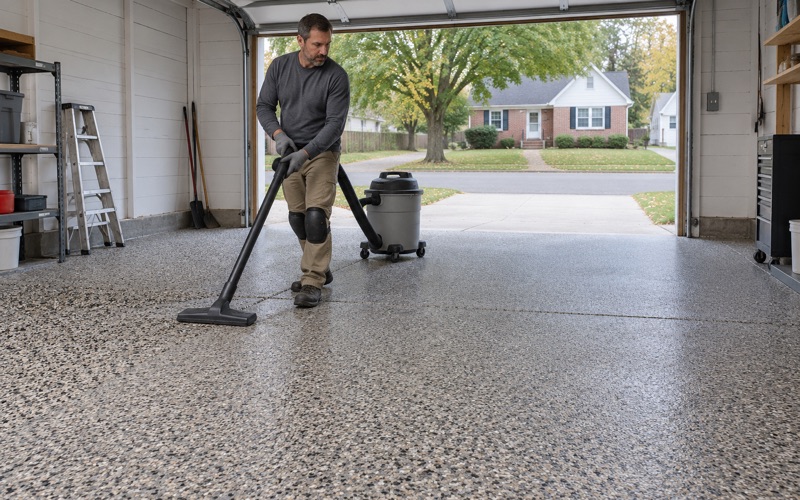
The approach carries over to garage and basement slabs across Camanche, Iowa, where most homes are owner-occupied and nearly half of the housing dates from the 1960s and 1970s. Much residential cracking comes from shrinkage or settlement rather than any reaction, but we map it the same way before we quote. If a crack pattern looks like it needs more than a coating, you hear that from us first.
On those slabs the system we recommend follows the conditions we find, from a 100% solids epoxy base with a vinyl flake broadcast to a polyaspartic topcoat chosen to stand up to the rock salt and brine that ride in on tires. Cure timing follows slab temperature and dew point rather than the calendar. And before the job is sold, we explain what the coating warranty excludes, starting with moisture and hydrostatic pressure.
- 20+ Years in Business
- Moisture Tested Before Pricing
- Free Written Estimates