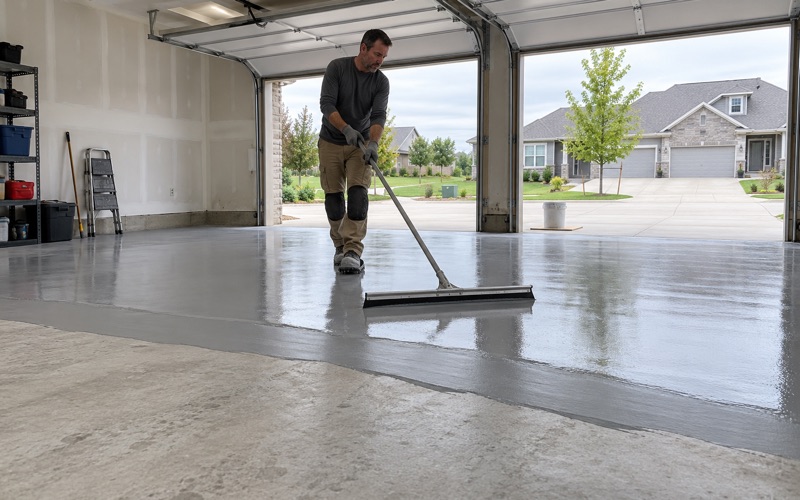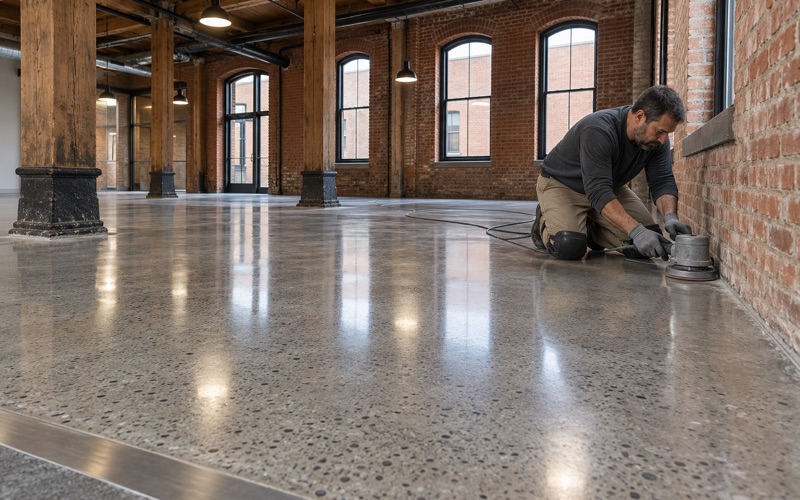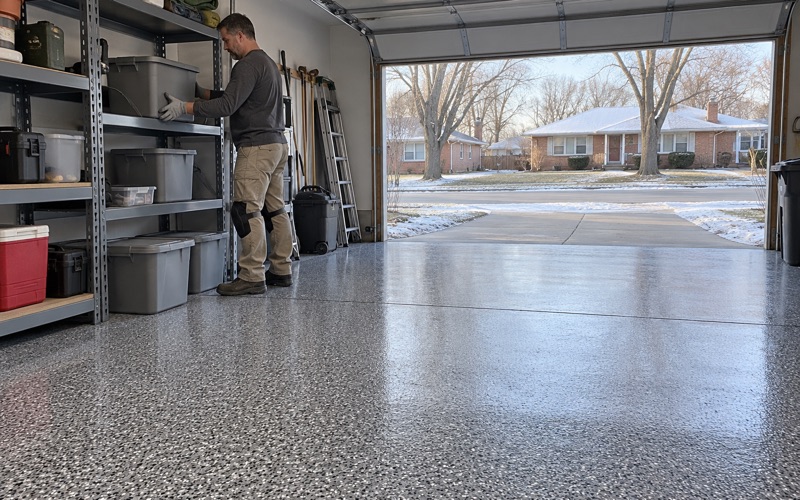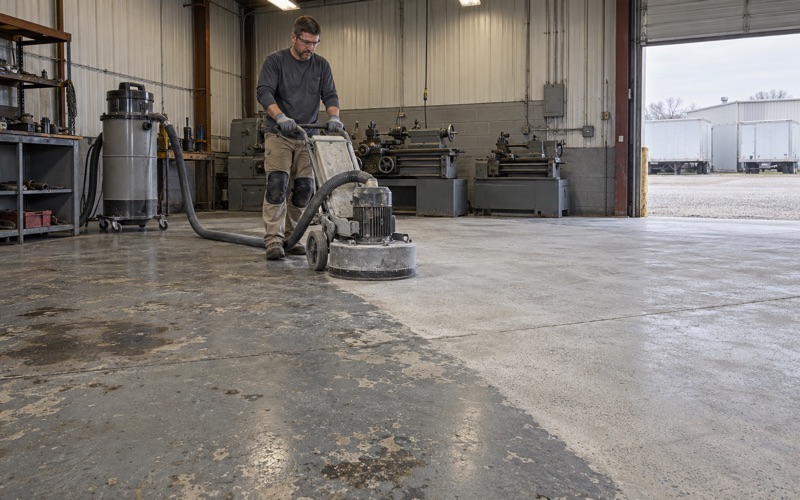
Davenport IA Epoxy Flooring has spent more than 20 years putting epoxy flooring in Campbell’s Island garages and shops, along with homes across the Quad Cities on both banks of the river. On this side of the water the work answers to Illinois coating rules, and we quote it that way from the first visit. A slab here gets the same opening every slab gets from us: a diamond grinder or a shot blaster, never an acid etch, and a proposal that names the surface profile we are grinding to.
What makes a job on the island different is not the concrete. It is the first night after the coat goes down, and the few weeks of summer when that night needs more planning than usual. Most of this page is about that window and how we handle it.
Before any of that, the scope is written down. A moisture test is part of the quote before the price is final, the product line and number of coats are named, and the finished thickness is stated so you can hold the floor up against the paper when we leave.
An Island in the Mississippi and the Week the Mayflies Rise
Campbell’s Island is an island and unincorporated community in the Mississippi River, sitting in Hampton Township in Rock Island County, Illinois. It lies next to East Moline and is tied to the city by a bridge. Almost every home on it is a detached house, and every one of them sits within a short walk of open river water.
That location matters for one stretch of the year. The large burrowing mayflies called Hexagenia live in the river bottom as nymphs, then come up and take wing as adults. The National Weather Service office in La Crosse, which tracked a massive emergence in June 2012, wrote that these mayflies generally emerge as winged adults in late June to early July.
When the Hatch Comes Up
The same National Weather Service write-up noted that the 2012 emergence along the Mississippi began just after 9:00 p.m. It also recorded that the weather radar in Davenport picked up the swarm, and that surface observers reported a moderate emergence on the river near Davenport a couple of days later. Local Quad Cities coverage has tied the big swarms of recent years to warm river water, with one large flight reported on July 3, 2020.
The exact night shifts from one summer to the next, and nobody hands out a forecast for this island in particular. What holds steady is the shape of it: a few weeks around the turn of June into July, with the flights starting after dark. That is enough to plan a floor around, and it is how we plan one here.
Why It Is a Floor Question at All
A mayfly hatch is mostly a nuisance for porches, streetlights and windshields. It becomes a flooring concern only when it overlaps with a freshly coated slab that has not yet set up. On the island, a garage sits close enough to the river that the overlap is worth taking seriously, even though we have no record of a floor here being spoiled by it.
Looking for epoxy-flooring closer to Silvis? See Epoxy-Flooring in Silvis.
Why a Lit Garage Draws Them In After Dark
The National Weather Service put it plainly: the adults are often attracted by lights. Its page described them piling up and dying on the pavement below lights, leaving a slippery mess. Adults can also travel several miles inland from the river, so a house on the water is about as close to the source as a garage can get.
Picture a coating day that runs long, as they sometimes do. The last coat goes on in the evening, the overhead fixtures are still burning so the crew can see, and the door is up for air. After about 9:00 p.m. that open, bright doorway is exactly what a rising swarm heads toward.
Porch and Garage Lights Do the Inviting
It is not only the work lights inside. A porch fixture over the side door, a motion light on the driveway or a lamp left on in a window all pull insects toward the house. Once they are milling around the outside of a garage, any opening lets them drift in and settle wherever they land.
We treat lighting on the island as part of the job plan rather than an afterthought. Before we start, we walk the outside of the garage with you and note every fixture that could be on during the first evening. Some of those are on timers or sensors that a homeowner forgets about until the night they matter.
What This Is Not
Nothing about a finished floor changes how insects behave. A cured epoxy or polyaspartic surface does not draw them, repel them or keep them out of a garage, and we will not describe a coating that way. The only thing we are managing here is the short stretch before the film has set, when anything that touches it can stay put.
What Lands in a Tacky Coat Stays in It
Coating makers are blunt about debris. The product data sheet for Sikafloor-315 N states that dust particles, dirt, steel shot and other contaminants will be permanently sealed into the cured film, showing up as surface defects on high gloss, thin coatings. A mayfly is larger than a grain of dust, and nothing in that wording suggests it would behave differently once it lands in a wet film.
The Gorilla garage floor kit instructions make the same point earlier in the process. They tell the installer not to walk on the etched floor or let debris enter the work area while it dries. The concern carries straight through to the coat itself, which is softer and more receptive than bare concrete.
How Long a Floor Stays Still Tacky
Tack does not end on a fixed clock. The Sikafloor-315 N sheet lists foot traffic at 24 hours at 68 degrees F, stretching to 48 hours at 50 degrees F and shortening to 18 hours at 86 degrees F. The Gorilla kit says light foot traffic can come in as little as 10 hours, then adds that if the floor is still tacky, you should allow additional time.
That last line is the one we work by. Whatever the label promises, a coat that is still tacky at dusk is still open to whatever lands on it overnight. On a summer evening on the island, that can mean the whole first night falls inside the hatch.
Repair Means Grinding, Not Wiping
Once something is set into a cured film, it does not lift off with a rag. Fixing it usually means sanding or grinding the spot and recoating, and on a broadcast flake or quartz floor the patch has to be blended into the pattern around it. Planning the night is far cheaper than repairing it, which is why we would rather move a date than gamble on one.
Scheduling the Cure Night and Keeping the Door Down
The simplest answer is timing. If your project can wait until mid-July or later, or can be done in late spring, the first night of cure falls outside the late June to early July window altogether. When we quote island garages in early summer, we raise that option before anything is booked.
Sometimes the calendar will not cooperate, because a car needs its space back or a move is coming. In that case we keep the date and change how the first night runs. The coat goes down early enough in the day that the crew is packed and gone well before dark, and the garage is sealed for the evening.
Door Down, Lights Off, Until It Is Past Tack
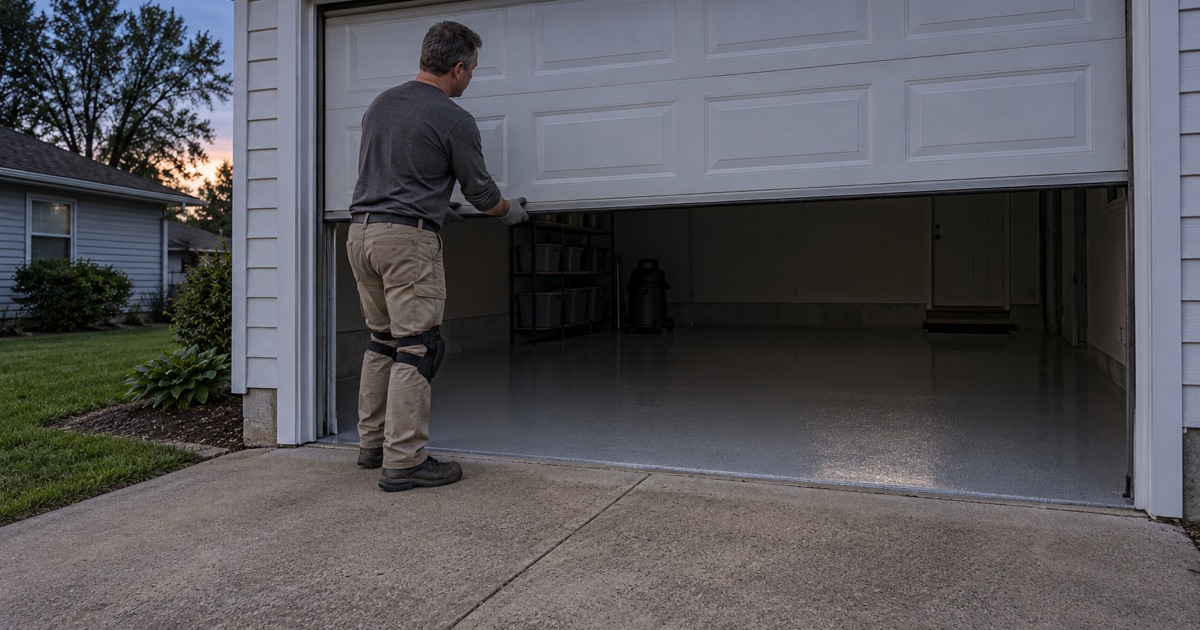
On a hatch-season job the rule is simple: from dusk until the floor is past tack, the overhead door stays shut and every light that faces the garage stays off. That includes the fixtures inside, the porch light by the side entry and any sensor light that might switch on when a raccoon walks by. We tape the edge where the door meets the floor when it closes, which the Gorilla instructions also call for, so the door seals cleanly against the fresh coat.
We check the floor in the morning before anyone walks on it. If it is still tacky, the door stays down and the lights stay off for another evening, rather than opening up because the label said it should be ready.
Paperwork on the Island
Because Campbell’s Island is unincorporated, permits for work here run through the Rock Island County Office of Zoning and Building Safety in Rock Island, not the City of East Moline, even though the mailing addresses say East Moline. The county asks contractors working in unincorporated areas to register each year, post a compliance bond and file a certificate of insurance, and it charges double for permits pulled after work starts. We explain those rules before a job is scheduled rather than claim a credential we cannot show you.
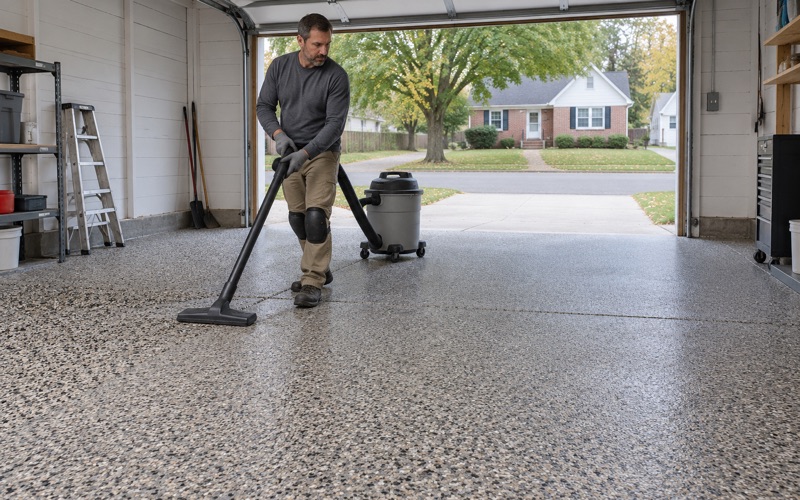
Most island homes draw their water from private wells, so we capture grinding dust at the machine with a vacuum instead of washing it toward a drain or the yard. Combined with a cure night planned around the river, that keeps a Campbell’s Island floor clean from the first pass of the grinder to the morning the door goes back up.
- 20+ Years in Business
- Moisture Tested Before Pricing
- Free Written Estimates