
Davenport IA Epoxy Flooring has installed commercial epoxy flooring for 20+ years in Davenport, IA, serving surrounding cities including Eldridge, Rock Island, Bettendorf, Moline and Milan. Commercial floors bring larger areas, tighter schedules, more paperwork and owners who cannot shut down for a week. We plan every job around those realities, phasing the work so stores, offices, clinics and shops can keep running.
The floor itself starts the same way as any of our jobs: the slab is diamond ground or shot blasted to a stated profile, cracks and old coatings are mapped, and a moisture test is in the scope before the final price. The written quote names the product line, coat count and finished thickness for each area. That lets a property manager or owner check the finished floor against the specification rather than taking it on trust.
We also handle the details that come with commercial work. That includes the certificate of insurance a permit office or general contractor needs, and a clear explanation of the state and city rules that apply to a coating job on each side of the river.
Commercial Floor Systems by Space
Retail Stores and Showrooms
Retail floors need to look good and clean easily under constant foot traffic, carts and display moves. A solid color, flake or metallic epoxy with a satin polyaspartic topcoat hides scuffs and keeps its color under storefront sunlight. Car dealerships and equipment showrooms often add a logo or border to the floor.
We work around store hours, often coating after close and reopening sections as they cure. Walk-off mats at the entry help keep grit off the finish through the salt months.
Offices, Clinics and Common Areas
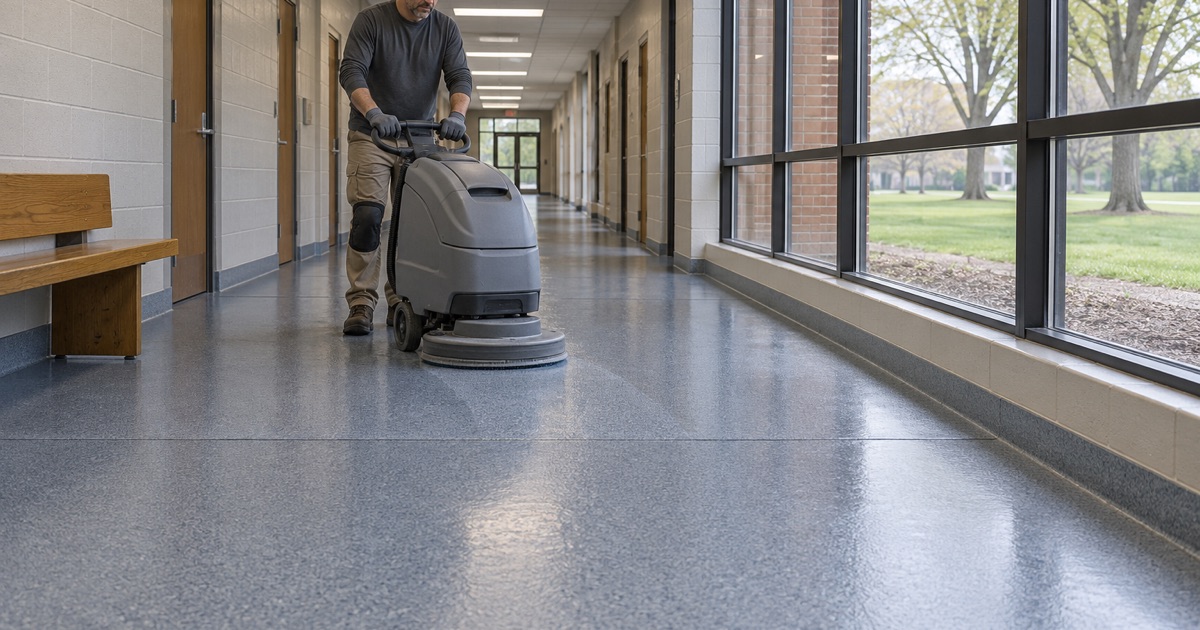
Offices, medical and dental clinics, salons and lobbies need seamless floors that sanitize easily and look finished. Epoxy with a urethane or polyaspartic topcoat resists the cleaners these spaces use daily. A matte or satin sheen cuts glare from overhead lights and windows.
In occupied buildings, we use low-odor products where possible and schedule the work for evenings or weekends. Dust from grinding is captured at the machine so it does not drift into nearby suites.
Auto Service, Fleet and Equipment Bays
Service bays, fleet garages and equipment dealers deal with oil, brake fluid, coolant, road salt and heavy tires. These floors need a thicker chemical-resistant body coat, a tough topcoat and some texture for footing on wet surfaces. Lift posts and jack points get extra build so steel feet do not dent the coating. A sealed floor also makes spill cleanup faster and keeps fluids on the surface rather than soaking into the concrete.
Scheduling Around a Working Business
Nights, Weekends and Phased Sections
We split larger floors into sections so part of the space stays open while another is being ground or coated. Work can run overnight or across a weekend when the building cannot close during the day. The schedule is written into the proposal so staff and customers can plan around it.
Phasing does add setup time, since each section needs its own masking, dust control and cure period. We weigh that against the cost of a full closure and lay out both options so you can choose the one that suits the business.
Fast-Cure Systems When Downtime Is Short
Polyaspartic topcoats and fast-cure primers can shorten the time before a floor takes foot traffic, sometimes to hours rather than days. They cost more and leave less working time, so we use them where the schedule calls for it. Standard epoxy remains the better choice where there is time and thickness matters.
Cure speed also depends on the building. A cold warehouse in January or a humid space in July changes how fast any coating sets, so we check slab temperature and dew point before each coat and adjust the reopening time to match.
Permits, Insurance and Coating Rules
Insurance and Contractor Registration
Commercial projects carry the certificate of insurance the permit office, owner or general contractor asks for. Iowa registers contractors under Iowa Code chapter 91C, and Davenport licenses construction contractors under City Code chapter 15.30. We walk you through which of those rules apply to your job.
Illinois-side cities set their own requirements, and some buildings add their own insurance minimums. We confirm those before the start date so the paperwork never holds up the floor.
VOC Rules on Both Sides of the River
The federal architectural coatings rule in 40 CFR 59 Subpart D sets national VOC limits for floor coatings. Illinois adds its own Part 223 limits on Illinois-side jobs. We quote each project under the rules for the state where the floor sits and choose products that meet them.
Slab Prep and Testing at Commercial Scale
Shot Blasting and Grinding Large Floors
Open commercial areas are often shot blasted for a fast, even profile, with grinders used along walls, columns and fixtures. Old coatings, adhesive from removed flooring and floor striping come off in the same step. Dust and debris are collected, never rinsed toward floor drains or storm inlets.
The proposal names the ICRI concrete surface profile for each area, since a thin sealer in an office and a thick build in a service bay need different textures. Matching the profile to the system is what keeps the coating bonded under traffic.
Moisture Testing New and Old Slabs
New construction slabs can take months to dry enough for a coating, and older slabs may sit on soil with a high water table. We test with ASTM F2170 relative humidity probes or ASTM F1869 calcium chloride kits and compare the readings with the manufacturer’s limits and ASTM F710 guidance. When readings are high, a moisture-mitigation primer goes down first.
Joints, Cracks and Trench Drains
Commercial slabs have more control joints, cracks and transitions than residential ones. We fill or honor joints based on how the slab moves, repair spalled edges, and finish the coating cleanly into trench drains and floor sinks so water still drains properly.
- 20+ Years in Business
- Moisture Tested Before Pricing
- Free Written Estimates