
Davenport IA Epoxy Flooring has repaired concrete floors for 20+ years in Davenport, IA, serving surrounding cities including Eldridge, Rock Island, Bettendorf, Moline and Milan. Most of that work happens on the way to a new coating or polish, because a floor system is only as sound as the slab under it. Cracks, spalls, salt-pitted surfaces and raised lips all have to be fixed first, or they show up again through the finished floor.
We map every crack, spall and old coating before the job is quoted, so repair work is in the price from the start rather than added halfway through. The proposal lists what will be repaired and with which materials. It also says plainly when a slab has moved, sunk or broken badly enough that it needs replacement before anything should be coated.
Repairs are done after the slab is ground open, when hollow patches and hidden damage are easiest to see. Dust is captured at the grinder, and nothing is rinsed toward a floor drain or the street.
Crack Repair Before a Coating
Hairline and Shrinkage Cracks
Almost every slab develops shrinkage cracks as it cures and ages. We open them with a crack chaser so the filler has room to bond, clean out debris and fill them with an epoxy or polyurea filler ground flush with the floor. Under a flake system, these repairs usually disappear.
Filling the crack before coating also keeps the coating from cracking along it right away. Without a fill, the coating simply bridges the gap and splits the first time the slab moves.
Moving and Structural Cracks
Some cracks open and close with temperature and moisture, and some have one side higher than the other. Those need a semi-rigid or flexible filler and, in some cases, a different approach to the coating over them. A crack with a growing offset or a sunken section next to it points to soil movement under the slab.
Those cracks get an honest conversation. Filling them is cosmetic, and the slab may need lifting, structural repair or replacement before a coating can last.
Control Joints
Control joints are cut into slabs so cracking happens in straight lines. They can be filled with semi-rigid joint filler for a smooth floor that is easier to clean, or left open and honored through the coating so the slab can still move. We explain the trade-off for your floor before choosing.
Spalls, Pitting and Salt Damage
Freeze-Thaw Scaling on Garage Slabs
Calcium chloride and rock salt dissolve into the slush carried in on tires, soak into the concrete and expand as they freeze. Over many winters, the top layer flakes off, leaving rough, pitted tire lanes. It is one of the most common kinds of damage on older garage floors in the Quad Cities.
We grind scaled areas back to sound concrete and rebuild them with epoxy repair mortar or a thin resurfacer. A sealed coating over the repair keeps salt water from soaking in again.
Spalled Joint Edges and Corners
The edges along control joints and cracks break down under tire, cart and forklift traffic, especially in shops and warehouses. Loose pieces are cut out to solid concrete, and the edge is rebuilt with a rigid repair mortar. A rebuilt edge stops the spall from spreading and gives the coating a solid edge to finish against.
Pitting, Pop-Outs and Old Patches
Pop-outs happen when aggregate near the surface breaks loose, leaving small craters. Old patches that have lost their bond sound hollow when tapped. We fill pop-outs and replace failed patches so the slab reads as one solid surface under the new floor.
Leveling and Trip Hazards
Grinding Down Lips and Raised Edges
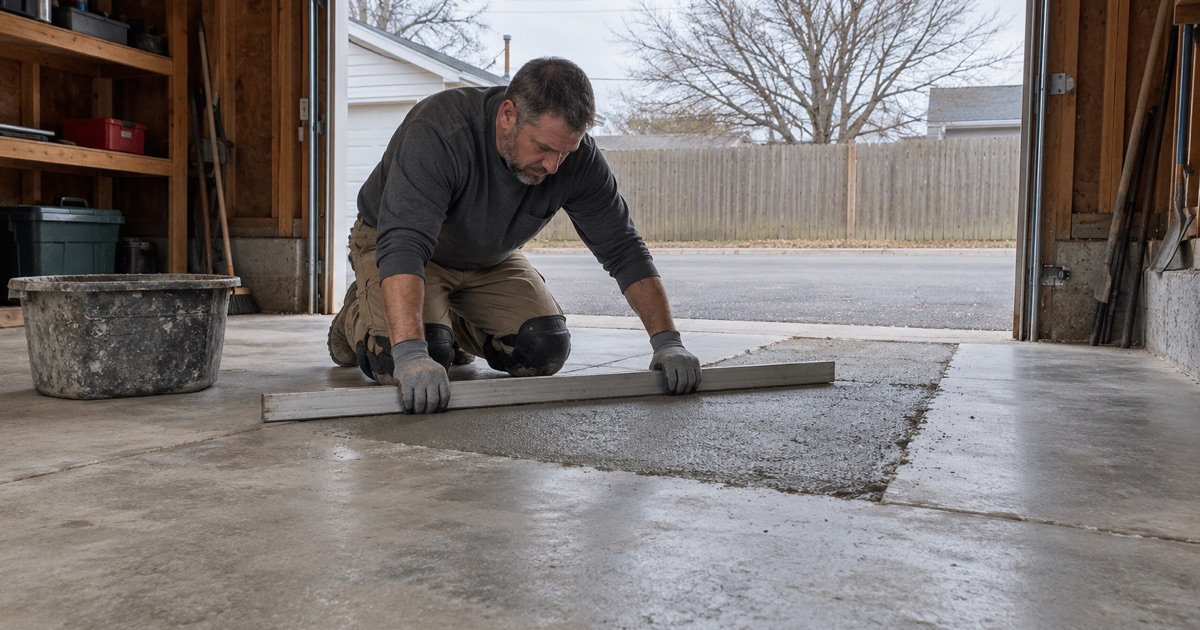
When one side of a crack or joint rises above the other, it creates a trip hazard and a ridge that shows through a thin coating. Grinding takes the high side down to match. This is often the most cost-effective fix for small vertical offsets in garages, basements and commercial aisles.
Filling Low Spots and Birdbaths
Low areas where water collects, often called birdbaths, are built up with patching or leveling material. That keeps meltwater and cleaning water moving toward the drain instead of pooling. We keep the slope toward floor drains and trench drains so the finished floor still sheds water.
On floors that will be polished rather than coated, leveling material shows as a different color from the surrounding concrete. We talk through where fills will be visible so the finished look is not a surprise.
When Repair Is Not Enough
Heaved, Sunken or Broken Slabs
A slab that has heaved, dropped several inches or broken into pieces that rock underfoot is past what surface repair can fix. Coating it would look good for a short time before cracking again along the same lines. We recommend lifting or replacement first and will coat the new or stabilized slab once it is ready.
Water-Related Damage in Basements
Cracks that leak water, efflorescence along cracks and damp patches tell us water is moving through the slab. Filling those cracks without solving the water problem only pushes water somewhere else. Drainage and dry-out come first, then moisture testing, then repair and coating.
Soft or Deteriorated Concrete
Some older slabs are soft and dusty all the way through, or have been damaged by chemicals in a shop. A scratch test and a test grind show how deep the weak concrete goes. Where it is shallow, grinding and a resurfacer can restore the surface; where it is deep, replacement is the honest recommendation.
- 20+ Years in Business
- Moisture Tested Before Pricing
- Free Written Estimates