Davenport IA Epoxy Flooring has spent more than 20 years on epoxy flooring in East Moline and across the river, and the jobs that take the most planning are rarely the biggest slabs. They are the floors inside buildings where several businesses share one roof, one air supply and one set of doors. In a building like that, the coating schedule belongs to everyone under the roof, not just to the owner who signed the proposal.
We start every East Moline job the same way: a diamond grinder or shot blaster opens the slab, a moisture test sits in the scope before the price is settled, and the quote spells out the product line, the coat count and the finished thickness. What changes from one building to the next is timing. A floor in a mixed-use building is planned around odor, airflow and the hours when nobody is working on the other side of the wall.
An Oil Change, a Coffee and a Manicure on 13th Street
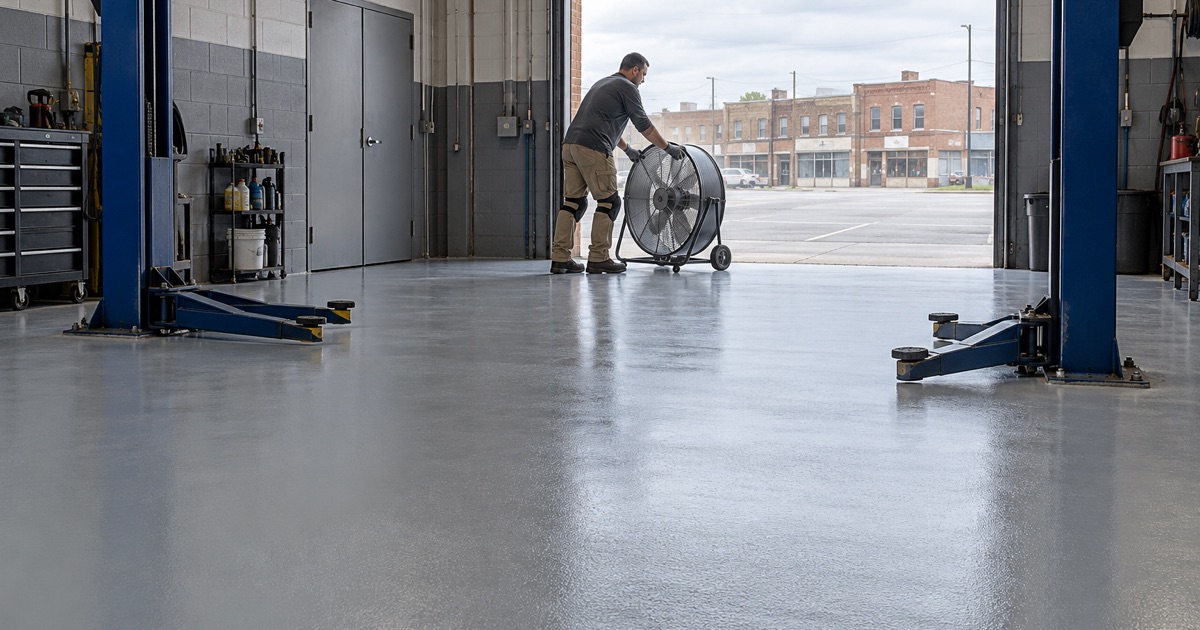
The clearest local example of a shared building sits at 807 13th Street. Open Bay Auto opened there in May 2026 with three service bays and a wash bay on one side, and a customer lobby on the other that holds a nail salon, the Fuel Station beverage bar, a reception desk and a meeting room. Double doors off the lobby lead straight to the shop floor, and customers get coffee, baked goods and nail services while their vehicles are worked on.
We have no connection to Open Bay Auto and have never seen its floors, its ventilation layout or its salon paperwork. We mention it because it shows, better than any hypothetical, how a modern East Moline business can stack very different uses inside one older building. The shop profile describes a 1950s or 1960s yellow brick building with a flat roof in a traditionally industrial part of the city.
One roof, one set of doors
When a repair bay, a beverage bar and a manicure station share a building, a floor project in any one of them is felt in all of them. Grinding noise carries, coating odor drifts through whatever doors and returns connect the rooms, and foot traffic has to route around a floor that is still curing. A pair of double doors is a convenience for customers and a planning problem for a coating crew.
That is why we ask who else occupies the building before we price anything. A tenant coating its own space may still need the landlord, the salon operator and the cafe to agree on a closed window. Open Bay Auto, for instance, publishes hours of 6:00 a.m. to 6:00 p.m. on weekdays and 6:00 a.m. to 4:00 p.m. on Saturdays and stays closed on Sundays, and a building with that kind of rhythm has one obvious day for floor work.
Older shells, newer uses
East Moline’s housing stock leans older, with 33.6 percent of the city’s housing units built in the 1950s and 1960s. Buildings from that era often carry patched slabs, old paint and sealers, and cracks that have moved over decades. We map those cracks, spalls and old coatings before quoting, and we say plainly when a slab needs repair before it is worth coating at all.
Looking for epoxy-flooring closer to Le Claire? See Le Claire Epoxy-Flooring.
What Illinois Asks of a Salon’s Air and Floor
Illinois sets sanitary standards for barber, cosmetology, esthetics, hair braiding and nail technology businesses in Title 68 of the Illinois Administrative Code, Section 1175.115. Two items in its list of sanitary requirements touch a floor project directly. One says floor surfaces shall be kept clean, orderly and in good repair, and the other requires that all salons and shops provide adequate ventilation as required by the city, county or municipality.
The ventilation item is the one that shapes our schedule. The rule’s stated purpose is keeping a salon free of excessive heat, steam, condensation, vapors, obnoxious odors, smoke and fumes. A floor coating applied anywhere in a shared building produces odor while it cures, so the salon’s duty to stay free of vapors and odors becomes part of how we plan a job in the room next door.
What the rule does and does not say
The rule names an outcome, not a product. It approves no coating, no brand and no installer, and no floor system can promise that a salon will pass an inspection. We read the rule as a reason to schedule carefully and choose materials thoughtfully, not as a sales line.
The ventilation standard also points back to local requirements, so the City of East Moline matters here. The city states that it has adopted and enforces the 2018 International Building Code and related 2018 codes. Questions about how a particular room is ventilated belong to the building owner, the design professional and the city, and we coordinate our work around whatever those decisions are rather than offering opinions on them.
Floors in good repair
The floor item is plain language: clean, orderly and in good repair. A chipped, peeling or cracked floor in a salon is harder to keep clean, and a coated surface without seams is easier to wipe down. That is a practical benefit we can describe honestly, without claiming any floor is salon compliant on its own.
Choosing a Coating and a Cure Schedule for a Shared Building
In a single-tenant garage, odor is mostly a comfort question. In a building where a nail salon or a coffee bar opens the next morning, odor and cure time decide the whole project. We plan backward from the hour the building reopens, and we pick the product and the number of coats to fit inside that closed window.
Product choice and odor
We can offer low-odor systems where they suit the slab and the use, and we present them as a comfort choice rather than a guarantee. No coating is odor free while it cures, and we will not promise otherwise. On Illinois-side jobs the applicator also answers to the state’s Part 223 limits on volatile organic compounds in floor coatings, which we follow on every East Moline project.
The choice usually comes down to three families: 100% solids epoxy for build and bond, polyaspartic topcoats where a faster return to service matters, and urethane cement where heat, hot water or heavy cleaning is part of daily life. Each cures on its own timeline, and that timeline is what we fit to the building’s closed hours.
Reading the slab, not the calendar
Cure schedules follow slab temperature and the dew point spread at the slab surface rather than a fixed number of hours on a calendar. A cold slab or humid air slows a cure and invites amine blush on epoxy, which leaves a waxy film that weakens the next coat. If the readings say the window is too short, we tell the owner before the work starts and move the date.
The moisture test comes first for the same reason. An ASTM F2170 in-situ relative humidity probe or an ASTM F1869 calcium chloride test tells us whether the slab can take a coating at all, and whether a moisture-mitigation primer belongs in the system. We explain what a warranty excludes before the job is sold, and moisture vapor transmission and hydrostatic pressure are the first exclusions we name.
Repair Bays, Wash Bays and the Customer Lobby
A building that combines a repair shop with customer space asks for different floors on each side of the doors. The service bays need a coating built for rolling loads and frequent cleaning, the wash bay sees standing water every day, and the lobby needs a surface that looks finished and stays comfortable underfoot. We quote those areas separately so each one gets the system that suits it.
Service bays and the wash bay
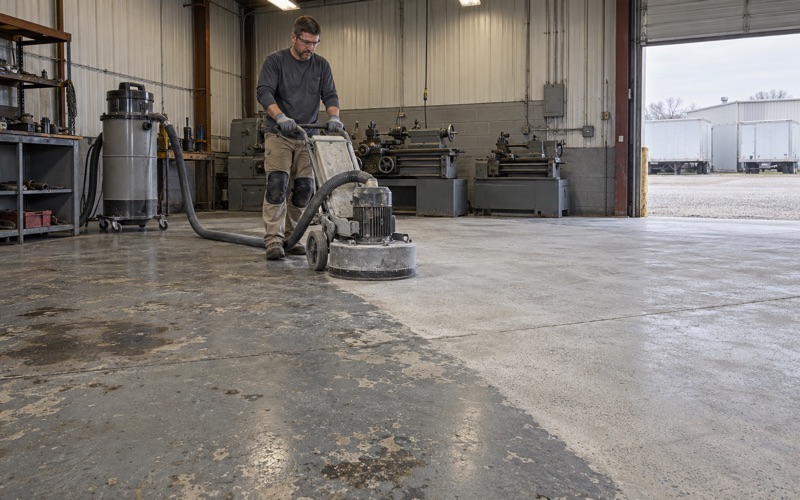
In service bays we grind to a profile that suits the chosen system and name that surface profile in the proposal. Grinding dust is captured at the machine with a vacuum rather than rinsed toward a floor drain, which matters in a building where the shop’s drains and the lobby’s air share the same structure. A vinyl flake or quartz aggregate broadcast adds texture where shop floors stay wet.
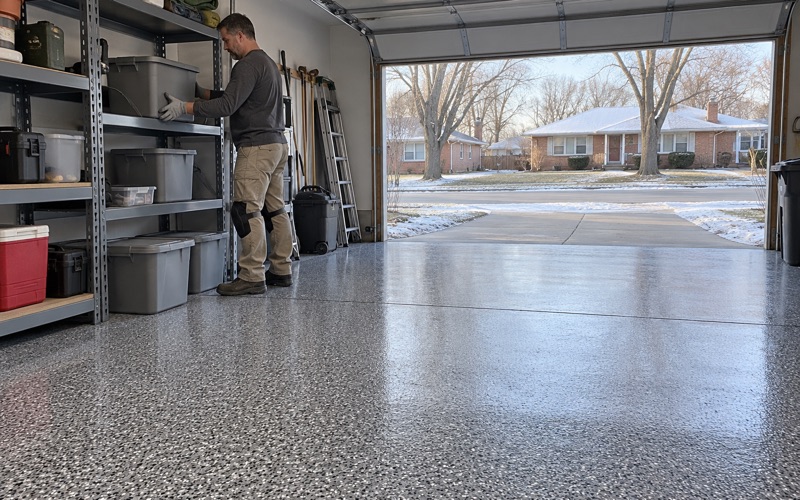
A wash bay is the wettest floor in the building and the one where traction counts most. Quartz broadcast in the body coat gives a finish that can be cleaned without becoming slick, and coved edges where the floor meets the wall keep water from sitting in the joint. We also check how the slab drains before we coat, because a coating follows the slope it is given.
The lobby side of the doors
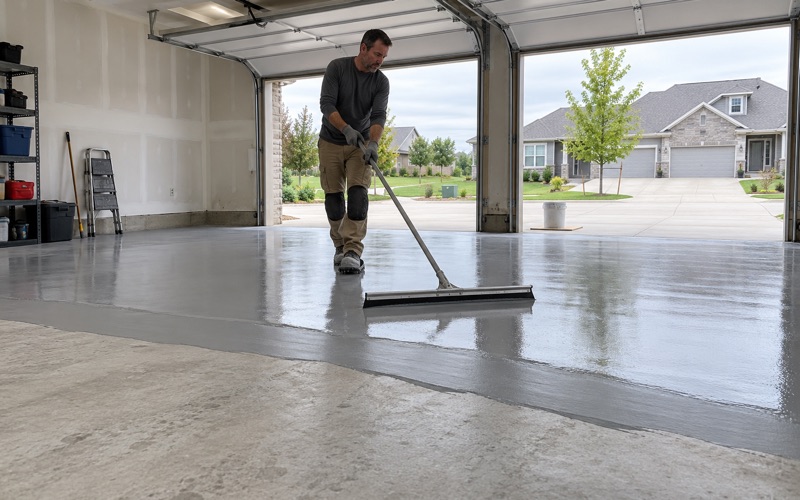
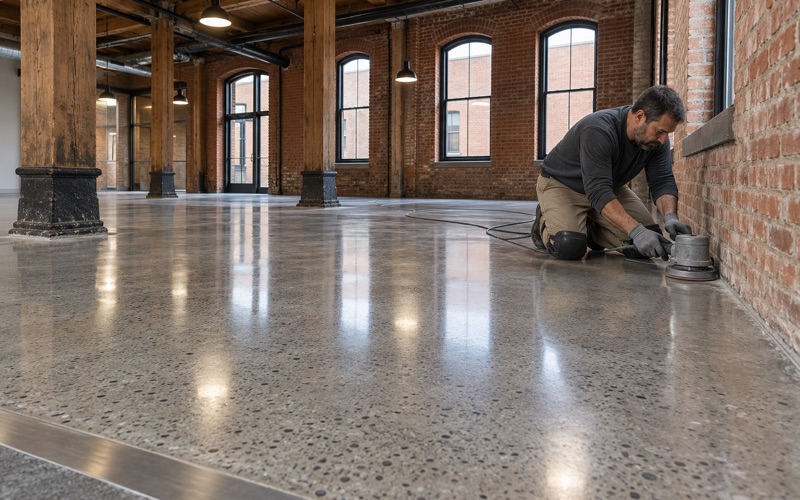
Lobby floors carry customers, chairs, carts and spilled drinks rather than vehicles. A thinner decorative system with a flake broadcast or a clear polyaspartic over a densified slab can work there, and it can often be scheduled for the same closed day as the shop side. Doing both in one window means the whole building reopens together instead of losing two days.
Phasing around a working building
When a building cannot close for long, we phase the work. One side can be ground and coated on a Sunday, with the other side taking a later closed day, so the business never loses its whole floor at once. That is the same approach we use for the larger industrial floors in the city, scaled down to a single shared building in East Moline, Illinois.
- 20+ Years in Business
- Moisture Tested Before Pricing
- Free Written Estimates