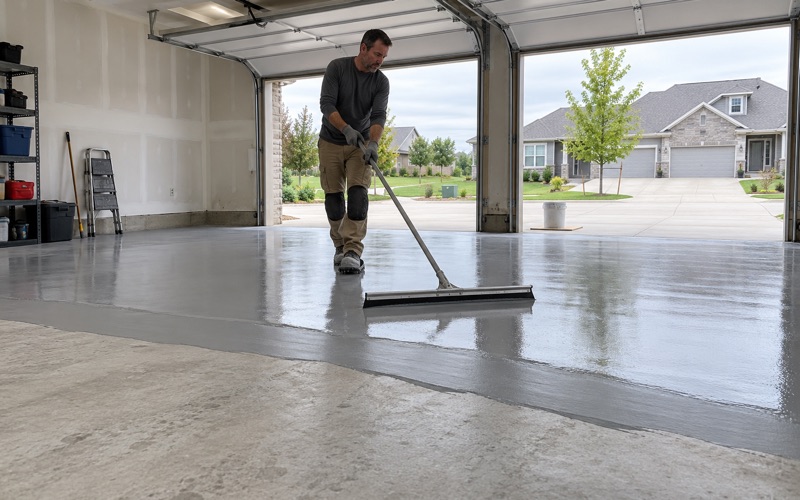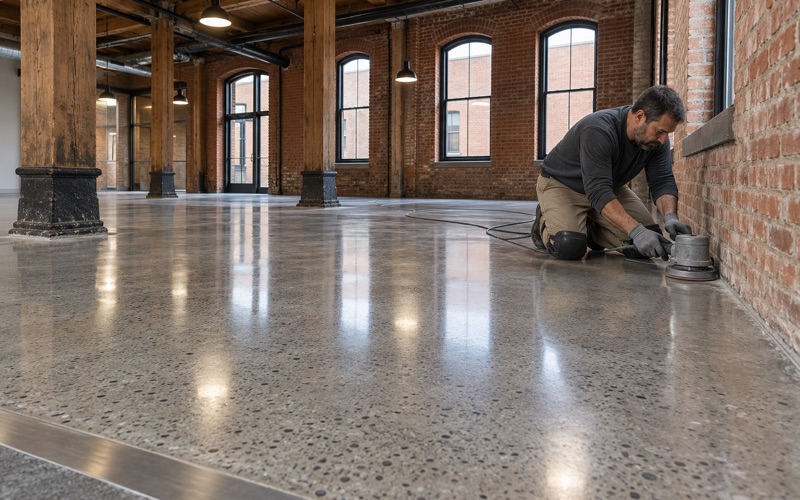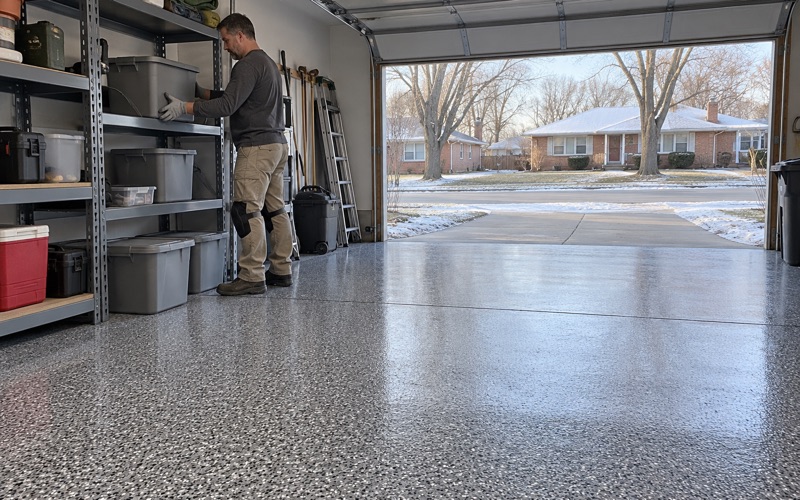
Davenport IA Epoxy Flooring has handled epoxy flooring in Eldridge for warehouse, shop and garage owners who need a coated slab without losing weeks of use, drawing on more than 20 years of grinding and coating concrete. Most of the work we quote here is a floor inside a building that is still doing its job, and the plan has to account for that from the first walkthrough.
Every slab we coat is opened mechanically, with a diamond grinder or a shot blaster, never an acid etch. Our proposal names the surface profile we are grinding to on the ICRI CSP scale, the product line, the number of coats and the finished thickness, so the floor you receive can be measured against the paper you signed.
The part of the job most owners never see is the dust. Grinding concrete releases respirable crystalline silica, and on an occupied floor that dust has to be caught at the machine rather than chased afterward. The sections below explain how we handle it, what the federal rule asks of a grinding crew, and how we stage the prep so a building can keep moving product.
A 424,000-Square-Foot Warehouse and a Floor That Keeps Shipping
Eldridge sits north of Davenport along U.S. Route 61, a Scott County city of 6,726 people at the 2020 Census that grew up as a grain and livestock shipping point. That shipping habit never really left. The city created industrial parks, and the buildings in them now move freight, machine parts and packaged goods rather than cattle.
The scale on South 1st Street
The clearest example is Logistic Services, LLC, the Hormel Foods dry-storage distribution center at 2951 South 1st Street. According to Hormel’s own careers page, the building covers 424,000 square feet, holds up to 30,000 pallets and employs 116 full-time and temporary workers. We have no connection to that facility and have never read its floors, but its size makes a useful yardstick for what a commercial floor job in Eldridge can look like.
A building on that scale is not something an operator closes for a week so the concrete can be ground. When we quote a distribution or storage floor anywhere in this part of town, we assume the doors stay open, the trucks keep arriving and the crew working beside us is somebody else’s.
Grinding next to people who are not on our crew
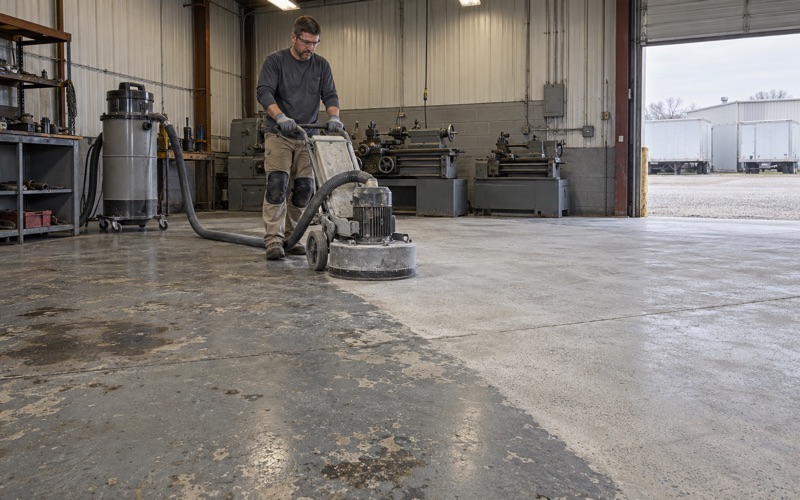
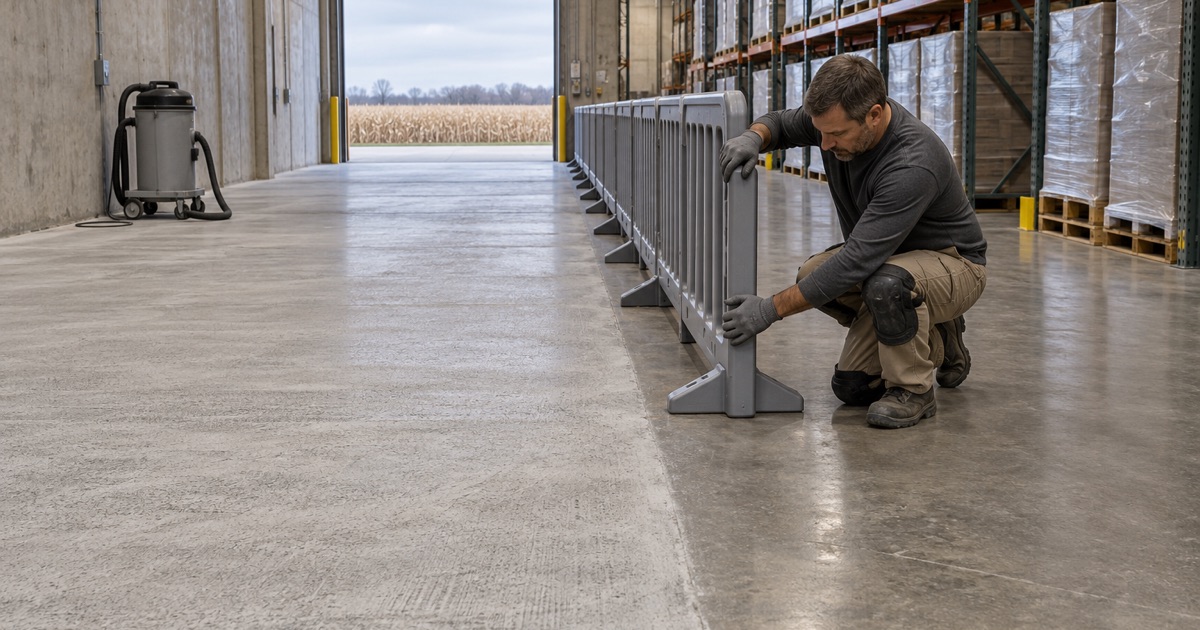
That assumption changes the whole prep plan. A diamond grinder on an occupied floor works in a cordoned bay while forklifts and pickers run in the next aisle over, so the dust cannot be allowed to drift and settle on stored product or on the people moving it.
It also changes the schedule. We break the floor into sections the operator can give up one at a time, and we agree on those sections, the walking routes around them and the hours before a grinder is unloaded. On an industrial job the floor plan is a working document, not a sketch.
Reading the slab before the price is set
Cracks, spalls, joint damage and any old coating are mapped before we quote, and if a section of slab should be repaired or replaced before it is coated, we say so plainly. A moisture test is written into the scope before the number is final, whether that means ASTM F2170 in-situ relative humidity probes or an ASTM F1869 calcium chloride test. A warehouse slab that looks dry on top can still push enough vapor to lift a 100% solids epoxy, and moisture vapor transmission and hydrostatic pressure are the first exclusions we name in any warranty discussion.
Looking for epoxy-flooring closer to Rock Island? See Epoxy-Flooring Services in Rock Island.
What OSHA’s Silica Table Says About Floor Grinders
The federal rule that governs our dust is 29 CFR 1926.1153, the respirable crystalline silica standard for construction. It applies to all occupational exposures to silica in construction work unless exposure stays below 25 micrograms per cubic meter as an 8-hour time-weighted average. Grinding a concrete floor to profile is squarely inside it.
Table 1, row thirteen
Table 1 of the standard lists specific tasks and the controls that satisfy the rule for each. Row thirteen covers walk-behind milling machines and floor grinders, which is the machine that does most of the work on a large slab. It offers two routes: a machine with an integrated water delivery system that continuously feeds water to the cutting surface, or a machine with the dust collection system the manufacturer recommends.
If the dry route is used, the dust collector has to provide at least the airflow the manufacturer recommends and carry a filter with 99 percent or greater efficiency plus a filter-cleaning mechanism. When either control is followed as written, the table calls for no respirator at any task duration. We run the vacuum-collector route on most interior floors, because slurry from wet grinding is its own cleanup problem inside a building full of stock.
The HEPA-filtered vacuum between passes
The same row adds a line that matters most on an indoor job. When the grinder is used indoors or in an enclosed area, a HEPA-filtered vacuum has to remove loose dust in between passes. A floor is rarely ground in one pass, so a properly run job is grind, vacuum, inspect, grind again, with the HEPA unit following the machine across each section.
That between-pass vacuuming does double duty for us. It keeps the fine dust from building up under the grinder heads, and it gives us a clean surface to check the profile against the CSP target named in the proposal before we move to the next pass.
Who the rule protects, and what it does not say
The silica standard protects the grinding crew’s own employees. It is a rule about how concrete is cut and ground, not a rating for a finished floor. No coating becomes OSHA approved because the prep followed Table 1, and we hold no OSHA certification of any kind. What we can show a facility manager is the equipment we bring and the cleanup method we follow.
No Dry Sweeping, No Compressed Air
The silica standard goes beyond the machine itself. Paragraph (f) of the rule covers housekeeping, and its two lines are blunt enough to quote almost word for word.
What paragraph (f) rules out
The first says dry sweeping or dry brushing is not allowed where it could contribute to employee exposure, unless wet sweeping or HEPA vacuuming is not feasible. The second bans using compressed air to clean clothing or surfaces. A push broom and a leaf blower are exactly the tools that turn settled silica back into breathing-zone dust, so neither belongs on our jobs.
On a floor we have ground, every cleanup pass is a vacuum pass. That holds for the open field of the slab, for the joint lines after they are routed, and for the edges along walls and columns where the walk-behind cannot reach.
Edges, corners and handheld grinders
The edges are handled with a handheld grinder, which falls under its own row of Table 1. Its water option is listed for outdoor tasks only, so indoors we use a shroud connected to a dust collector sized to the wheel diameter. A long day of indoor edge work can also call for a respirator under that row, and we plan the crew’s hours accordingly.
Where the dust ends up
We capture grinding dust in the collector and bag it, rather than rinsing it toward a floor drain or out a dock door toward a storm inlet. A floor drain looks like a convenient place to send slurry, and it is the wrong one. The bagged dust leaves with our equipment at the end of each shift.
Phasing Prep Around Working Aisles in Eldridge’s Industrial Parks
The industrial side of Eldridge keeps growing. In September 2025 the city’s Committee of the Whole heard from a commercial broker that in-city sites were ready for development, that more land was being rezoned for industrial use, and that spec buildings had been in high demand. Along Slopertown Road, TCC Materials broke ground in 2021 on a cement products packaging plant with multiple production lines.
Working the floor in sections
For an existing building that cannot stop, we phase the prep. A typical sequence is one bay ground, vacuumed and profiled, then primed, then returned to service once the coating has cured enough for traffic, before the next bay is opened. The operator decides which zone goes first, and we size each zone to what the building can live without.
Where a section cannot be given up during the day, we schedule overnight and weekend windows. A crew that arrives at 6:00 p.m. on a Friday can often grind and prime a section that is back under foot traffic by Monday morning, depending on the product line and the slab conditions.
Cure by slab temperature, not the calendar
The cure schedule follows the slab, not the date on the work order. We read slab temperature and the dew point spread at the slab surface before we mix, because a cold slab near the dew point invites amine blush on an epoxy coat and a weak bond for whatever goes over it. An unheated building in January may be told to wait, or to run temporary heat long enough for the concrete itself to warm.
Where an owner needs the floor back faster, a polyaspartic topcoat over an epoxy base can shorten the return-to-service window. We write the expected walk-on and drive-on times into the proposal so the shift supervisor can plan around real numbers.
Paperwork the job carries
Commercial projects carry the certificate of insurance a permit office or property manager asks for. Iowa Code chapter 91C sets up contractor registration, which is a registration rather than a license, and the City of Eldridge is the building authority for work inside city limits. We explain those rules rather than claim a credential we do not hold.
Iowa has no state VOC rule for floor coatings beyond the national architectural coatings rule that binds manufacturers, so a low-odor product is a comfort choice for the people working nearby, not a legal requirement. In a building where a crew keeps working while we coat, that comfort choice is often the right one.
- 20+ Years in Business
- Moisture Tested Before Pricing
- Free Written Estimates