
Davenport IA Epoxy Flooring has installed ESD flooring for 20+ years in Davenport, IA, serving surrounding cities including Eldridge, Rock Island, Bettendorf, Moline and Milan. An ESD floor, short for electrostatic discharge, is a coating built to carry static charge safely to ground. It protects sensitive electronics from the small sparks people generate just by walking, which can damage circuit boards and components without anyone noticing at the time.
These floors are a technical product, not a decorative one, and they only work if every layer is installed correctly. The slab is diamond ground to a named surface profile and moisture tested before pricing, a copper grounding grid is laid and tied to building ground, and the conductive layers go down in sequence. The written proposal names the product line, coat count, finished thickness and the resistance range the floor is meant to meet.
When the floor cures, we test it. You receive resistance readings taken at points across the room, so the floor can be checked against your specification instead of being accepted on appearance.
What ESD Flooring Does
Static Discharge and Sensitive Electronics
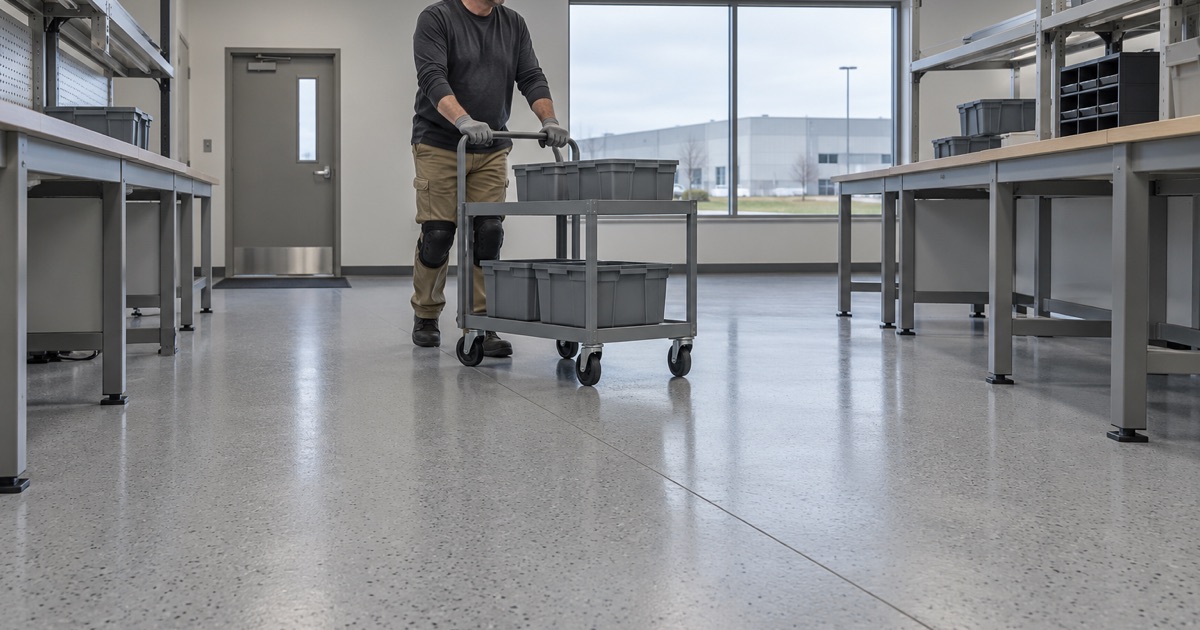
Every step on an ordinary floor can build static charge on a person’s body. When that person touches a circuit board, a server or a test instrument, the charge jumps, and even a discharge too small to feel can damage or weaken a component. An ESD floor gives that charge a controlled path to ground through the person’s footwear. The result is fewer hidden defects, fewer field failures and a work area that meets the ESD program a customer or manufacturer may require.
Conductive and Static-Dissipative Ranges
ESD floors fall into two broad classes based on electrical resistance. Conductive floors have lower resistance and drain charge very quickly, while static-dissipative floors have higher resistance and drain charge in a slower, controlled way. Each has its place, and using the wrong one can create its own problems.
Your ESD control program, equipment maker or customer usually specifies the range. We select the coating system that is rated for that range and confirm it after installation.
The Floor Is One Part of a System
An ESD floor only works together with what stands on it. Heel straps, ESD shoes, grounded workbenches and wrist straps complete the path, and standard rubber-soled shoes can block it entirely. Programs built on ANSI/ESD S20.20 treat the floor, footwear and people as one system and test them together. We focus on the floor itself and coordinate with whoever manages your ESD program so the pieces fit.
Where ESD Floors Are Used
Electronics Assembly and Repair
Circuit board assembly, electronics repair benches and component storage areas are the classic ESD spaces. Manufacturers along the I-80 corridor and in the Eastern Iowa Industrial Center may need these floors in production cells, test labs or kitting areas. Smaller repair shops and contract manufacturers use them as well.
Server Rooms, Telecom and Control Rooms
Server rooms, network closets, telecom switch rooms and control rooms hold equipment that is costly to replace and hard to take offline. A static-dissipative floor reduces discharge risk when technicians work inside racks. These floors are often installed over weekends or planned outages so the systems stay up.
Labs and Clinics With Sensitive Equipment
Research labs, testing facilities and some medical and dental spaces contain instruments that do not tolerate static well. An ESD floor provides a seamless, cleanable surface that also protects the equipment. The resistance range is set by the equipment and the facility’s own requirements.
How an ESD Epoxy Floor Is Installed
Copper Grounding Grid
After the slab is ground and repaired, thin copper strips are laid in a grid across the floor and connected to a verified building ground point. The grid gives charge collected by the coating a short path to ground from anywhere in the room. Grounding connections are made at the locations your electrician approves.
Conductive Primer and ESD Body Coat
A conductive primer goes down over the grid to spread charge laterally across the floor. The ESD body coat or topcoat contains conductive fibers or fillers that carry charge from the surface down to the primer. Each layer is applied at a controlled thickness, because too much or too little changes the floor’s resistance. We check slab temperature and the dew point spread at the surface before each coat, since a poor cure affects both bond and electrical performance.
Resistance Testing After Installation
Once cured, the floor is tested using the ANSI/ESD S7.1 method, measuring point-to-point and point-to-ground resistance at locations across the room. We record the readings and hand them over with the floor. Any area that reads outside the range is identified and corrected before the job is closed.
Prep, Moisture and Upkeep
Slab Preparation and Moisture Testing
ESD systems need the same solid base as any other coating. Old coatings and adhesives are ground off, cracks are filled and moisture is tested with ASTM F1869 or ASTM F2170 methods. A moisture-mitigation primer goes down when the slab reads high, so vapor does not lift the system and break the conductive path.
Cleaning Without Insulating Films
Waxes, floor finishes and some general-purpose cleaners leave a film that raises surface resistance and makes the floor less effective. ESD floors should be cleaned with products made for them. We leave cleaning guidance with the floor and recommend periodic resistance checks as part of your ESD program.
- 20+ Years in Business
- Moisture Tested Before Pricing
- Free Written Estimates