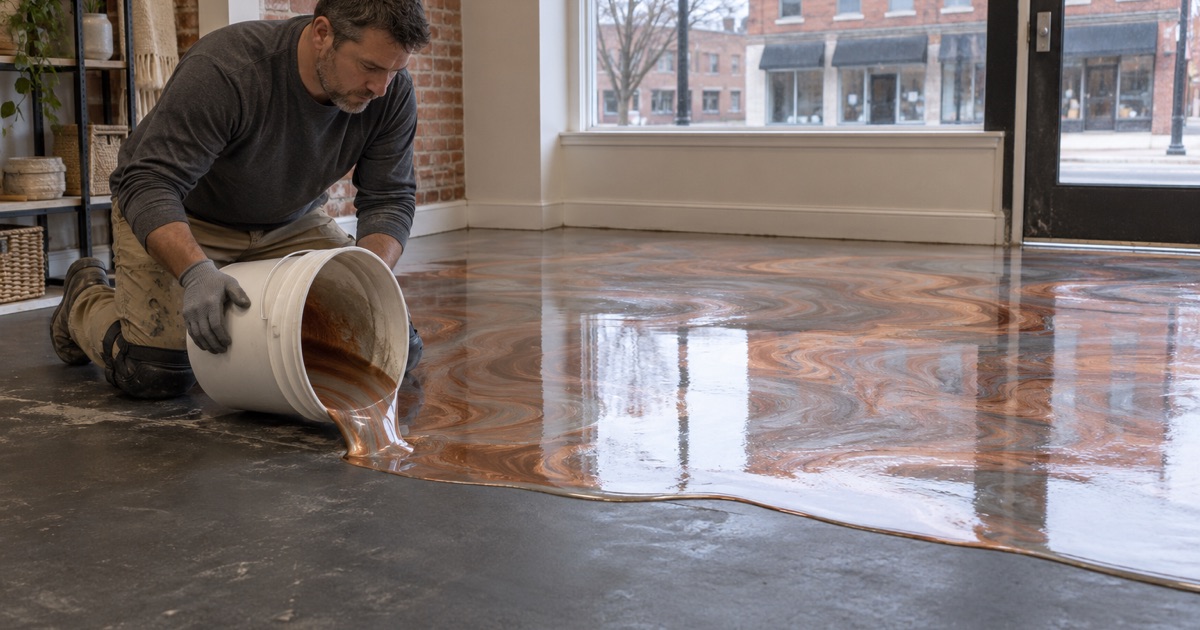
Davenport IA Epoxy Flooring has poured metallic epoxy floors for 20+ years in Davenport, IA, serving surrounding cities including Eldridge, Rock Island, Bettendorf, Moline and Milan. A metallic floor uses pearlescent pigments suspended in clear epoxy, which drift and swirl while the resin is wet to create depth that looks like polished stone, flowing water or molten metal. Each floor ends up unique, which is the main reason people choose it.
That look comes with stricter demands than any other coating we install. Every flaw in the slab, every roller mark and every patch can show through a metallic layer, so preparation and technique carry more weight here than on flake or solid floors. The slab is diamond ground to a named surface profile, tested for moisture before pricing, and repaired and leveled until it is ready for a decorative pour.
The proposal states the base color, metallic pigments, coat count, finished thickness and topcoat. That lets you compare the finished floor against what you agreed to, which matters on a product where the pattern itself is different every time.
How a Metallic Epoxy Floor Gets Its Look
Pearlescent Pigments in Clear Epoxy
Metallic pigments are fine reflective particles mixed into 100% solids epoxy. As the epoxy is spread and worked, the particles move and catch light at different angles, which creates the swirls, veins and cells that define a metallic floor. Tools, solvents and the direction of each pass all change the pattern.
Because the pigments keep moving until the epoxy sets, the installer is shaping the floor in real time. That calls for epoxy with enough working time, which is one reason metallic layers are not made with fast-curing polyaspartic.
Base Coat Color and Layering
A tinted base coat goes down first and affects the final look as much as the metallic layer on top. A dark base deepens the shine and contrast, while a light base gives a softer, brighter floor. Some floors use two metallic colors worked into each other for a marble or lava effect.
We help you choose combinations using samples and photos of past floors. Seeing color on an actual sample under your room’s lighting avoids surprises.
Where Metallic Floors Work Best
Finished Basements and Living Spaces
Metallic epoxy is popular in finished basements, home bars, family rooms and theaters, where it replaces carpet or tile with a seamless, easy-to-clean floor. It reflects light, which helps lower-level spaces feel brighter. The basement slab still has to pass a moisture test, and older floors in the area often need paint, glue and patches removed first.
Where the readings run high, a moisture-mitigation primer goes under the metallic system. If water is getting into the basement, that problem has to be solved before any decorative floor is worth installing.
Showrooms, Retail Stores and Offices
Car dealerships, salons, boutiques and offices use metallic floors to make a strong first impression. The coating is seamless and cleans easily, and colors can match a brand palette. For commercial projects we plan the work around business hours and provide the certificate of insurance the building or permit office asks for. Heavy rolling loads and grit from outdoor traffic will scratch a high-gloss finish, so we usually recommend a satin topcoat and walk-off mats at the entry.
Show Garages and Their Limits
Some homeowners want a metallic finish in the garage, and it can look striking. In a Quad Cities winter, though, road salt, slush and grit come in on every tire. A metallic floor shows that wear faster than a flake floor, so we recommend it for show garages and lightly used spaces rather than a daily parking spot.
Slab Requirements for a Metallic Pour
Flatness, Cracks and Repairs
Metallic layers are thin and reflective, so low spots, ridges and trowel marks show clearly. We grind high spots, fill low areas and smooth joints before the base coat. Cracks are routed and filled, but filled cracks and patches may still show as a line or shift in pattern.
We point those areas out before work starts. Some people embrace them as character; others prefer a different system.
Moisture and Temperature During the Pour
Vapor coming up through the slab can cause bubbles and pinholes that ruin a decorative finish. Testing comes first, followed by the primer the readings call for. During the install we also check slab temperature and the dew point spread at the surface, because a cold or damp surface affects how the pigments move and how the epoxy cures.
Metallic Epoxy Compared With Other Decorative Floors
Metallic Epoxy or a Flake Floor
A flake floor is the forgiving choice: the broadcast chips hide dust, small scratches, filled cracks and slab patches, and the texture gives a bit of grip. A metallic floor is the dramatic choice, with depth and movement no flake blend can match, but it rewards a flat slab and regular dust-mopping. If the space takes heavy daily wear, flake usually lasts better looking; if it is a room people show off, metallic usually wins.
Some homeowners split the difference, putting flake in the garage and a metallic floor in the finished basement. Both systems use the same ground slab, moisture testing and topcoat approach.
Metallic Epoxy or Polished Concrete
Polished concrete gives a natural stone look by grinding and densifying the slab itself, so the result depends on the concrete already there. A metallic coating covers the slab completely and lets you choose the color and pattern. Where an old slab is stained, patched or soft, metallic epoxy usually produces the more even result, while a sound slab with attractive aggregate may be better left polished.
Protecting the Finish
UV-Stable Topcoats
Many epoxies amber in sunlight, which can dull a metallic floor near windows or garage doors. A polyaspartic or polyurea topcoat is UV-stable and adds abrasion resistance. It is the layer that takes daily wear and can be renewed later without disturbing the decorative layer.
Gloss, Satin and Anti-Slip Options
High gloss shows off the depth of the metallic layer but also shows dust and scratches. Satin softens glare and hides wear, and a clear anti-slip additive can be mixed into the topcoat for spaces that may get wet.
- 20+ Years in Business
- Moisture Tested Before Pricing
- Free Written Estimates