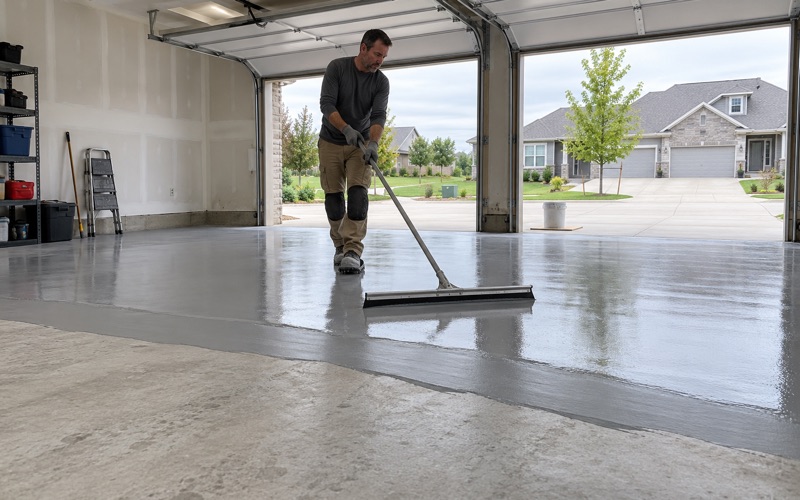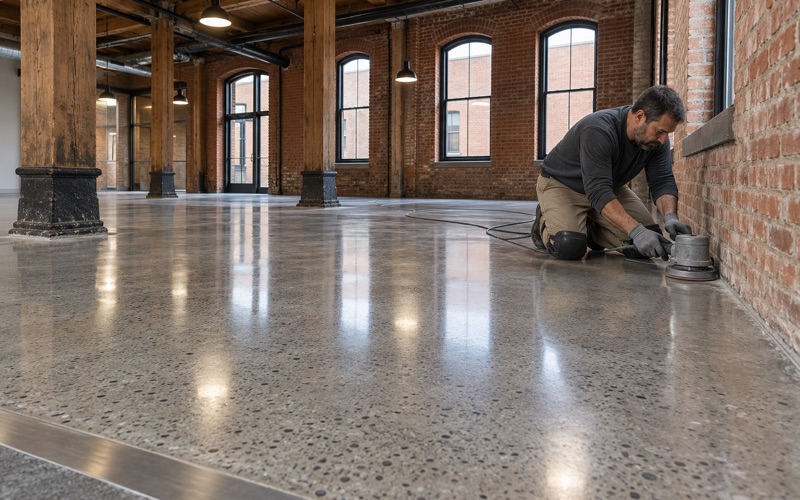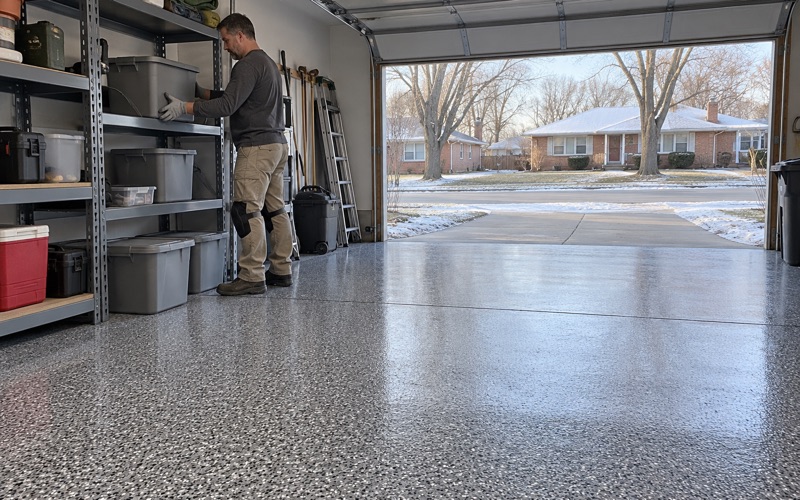
Davenport IA Epoxy Flooring has spent more than 20 years putting down epoxy flooring in Milan and the rest of the Quad Cities, and the question we start with here is simple: what is going to wear this floor out? In a garage the answer is tires and road salt. In a room full of tables and chairs that get rearranged every few days, the answer is scuffing, and that changes which layer of the system matters most.
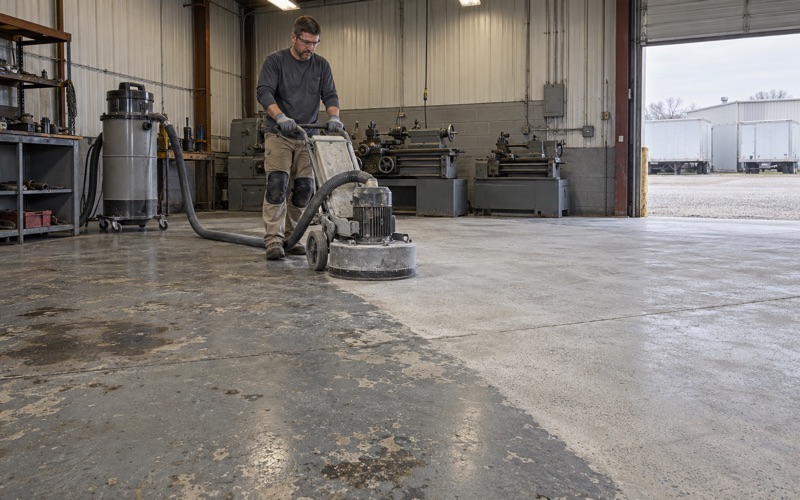
We build every floor the same honest way. The slab is opened with a diamond grinder or a shot blaster instead of an acid wash, and our proposal states the surface profile we are grinding to. A moisture test is part of the written scope before the number is final, and the quote spells out the product line, the coat count and the finished thickness so you can hold the result against it.
What changes from job to job is the top of the system. On this page we explain how we pick that wear layer for floors in Milan, Illinois that take furniture traffic, how makers publish the numbers we compare, and why the topcoat is the part we plan to renew.
A Hall Floor in Milan That Is Set and Struck Every Weekend
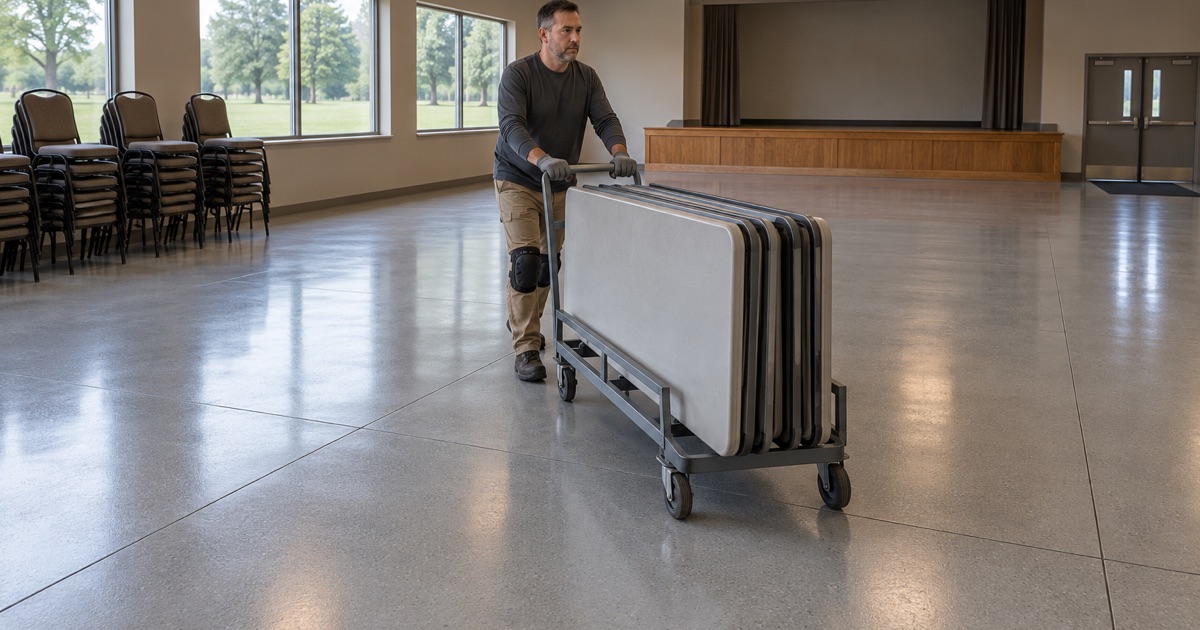
Milan is a village of 5,097 people in Rock Island County, Illinois, and one of its busiest public rooms is the Camden Centre at 2701 1st Street East. It sits inside the 90-acre Camden Park, it is operated by the Village of Milan as a banquet and event venue, and its listing describes seating for up to 350 guests in a remodeled facility. The village rents it for 12 hours at a time, and cake, gift, buffet and bridal party tables are set to each client’s specification.
We have not seen the Camden Centre’s floor, and nothing we read says what surface it has. We bring it up because it is the clearest local picture of a type of room: a hall that is set up and taken down for every event. Church fellowship halls, lodge rooms, club meeting spaces and commercial party rooms in and around Milan share the same pattern on a smaller scale.
Why furniture wears a floor differently than cars
A garage floor fails under heat, salt brine and hot tire pickup, and the coating has to resist softening and chemical attack. A banquet floor rarely sees any of that. Its wear comes from chair legs scraped back from tables, stacks of chairs slid toward a storage room, table feet dragged into new rows, and grit carried in on shoes and ground in by all of that motion.
That is abrasion, and it attacks the very top of the coating first. The surface goes dull in the paths people use most, fine scratches collect where chairs are pushed out, and eventually the gloss in the middle of the room no longer matches the corners. None of it is a structural failure, but it is the part of the floor every guest sees.
What a set-and-strike schedule does to the surface
In a room rented in long blocks and reconfigured for each client, the same strips of floor are crossed many times in a single weekend. Setup crews tend to drag rather than lift when they are moving dozens of chairs on a deadline. That repetition is why we treat the top layer as the part of the floor that is chosen for the wear and planned for renewal, rather than a cosmetic finish added at the end.
Looking for epoxy-flooring closer to Campbell’s Island? See Campbell’s Island Epoxy-Flooring.
What a Taber Abrasion Number Tells You
Coating makers do not leave scuff resistance to adjectives. Many publish a Taber abrasion result on the product data sheet, measured under ASTM D4060. A coated panel spins under a pair of abrasive wheels for a set number of cycles, and the lab weighs how much coating came off.
Reading the figure
The result is reported as milligrams lost, and lower is better, because less coating was worn away. The test conditions matter, so we always read them alongside the number: the wheel type, the load on the wheel and the cycle count. Two figures are only comparable when they were run the same way, which is why we check the fine print before we compare one product to another.
Two published figures show how far apart the layers in one system can sit. Sika’s data sheet for Sikafloor-315 N, a clear topcoat, lists an abrasion resistance of 18 mg loss in its smooth high-gloss form, tested on a CS-17 wheel with a 1,000 g load over 1,000 cycles. Sika’s data sheet for Sikafloor-264, an epoxy body coat, lists 90 mg loss under the same wheel, load and cycle count. On that one test, the topcoat lost a fraction of what the epoxy did.
What the number does not tell you
A Taber abrasion figure is a lab value for one product under one set of conditions. It is not a field life, and we will not turn milligrams into years or promise that any floor never wears. Grit, the way furniture is moved, how often the floor is cleaned and how it is cleaned all change what a real room does to a coating.
What the number does give you is a fair way to compare candidate wear layers before anything is installed. When we propose a topcoat for a floor that takes furniture traffic, we can show you the maker’s published abrasion result and the conditions behind it, so the choice is visible rather than a matter of trust. We have no relationship with Sika or any other maker; we cite the sheets because they are public.
Body Coat and Topcoat Do Different Jobs
A good epoxy floor is a system of layers, and each one has a task. Treating the whole thing as one product is how a room ends up with a strong floor that looks worn within a season, or a glossy floor that cannot hold up underneath.
The body coat carries the floor
The body coat, often a 100% solids epoxy, is the part that bonds to the ground concrete, fills the profile we cut, and builds thickness. It carries any vinyl flake or quartz aggregate broadcast, and it is where the color and pattern usually live. Its job is adhesion, build and toughness, and epoxy does that work well.
What the body coat should not be asked to do is take every chair leg directly. Left exposed in a room that is reset constantly, an epoxy surface will dull and scratch faster than a coating made for that duty. The data sheet figures above show why.
The topcoat takes the scuffing
The topcoat is the wear layer. On a floor that sees furniture more than tires, we look at clear urethane, polyaspartic and polyurea topcoats and compare their published abrasion results, gloss and texture. A smooth high-gloss finish looks sharp in a hall, while a textured finish with a fine wear aggregate gives up a little shine for better grip and a surface that hides light scratching.
We talk through that trade with you in plain terms. A room used for receptions, dances and dinners has different priorities than a shop floor, and the topcoat is where those priorities are settled. The quote names the topcoat product and how many coats of it you are getting.
Preparation still decides the outcome
No topcoat saves a floor that was not prepared. Before quoting, we map cracks, spalls and any old coating, and we say so plainly when a slab needs repair before it should be coated. Grinding dust is captured at the machine by a vacuum, never rinsed toward a floor drain, and cure timing follows the slab temperature and the dew point rather than a date on a calendar.
Renewing the Top Layer Before the Color Wears Through
The advantage of a separate wear layer is that it can be renewed. When the topcoat in the busiest paths starts to look dull, the system underneath is usually still sound. At that point the floor can be cleaned, lightly abraded and recoated with the same topcoat, which costs far less than grinding the whole system off and starting again.
Watching for the right moment
The signs are easy to spot once you know them. Gloss fades in the traffic lanes between tables, scratches collect at the head of the buffet line, and the area by the chair storage room looks hazy compared with the rest of the hall. If the topcoat is renewed then, the colored body coat never takes the abuse directly.
Wait too long and the scuffing reaches the color layer. Once that happens, the worn spots no longer match the rest of the floor, and a clear recoat will not hide the difference. Planning the renewal around a slower month, between bookings, keeps a rented room from losing weekends to floor work.
Scheduling work in Milan, Illinois
For halls, offices and businesses that cannot close for long, we phase the job around the calendar, with overnight and weekend windows when the room has to stay in service. Milan’s housing is about two-thirds owner-occupied, and many homes date from the 1950s through the 1970s, so we also see plenty of older garage and basement slabs that call for a careful moisture read before anything is coated.
On the paperwork side, the Village of Milan issues building permits and requires a contractor applying for one to be registered with the village, including a $10,000 surety bond, liability insurance and workers’ compensation proof. We explain how that applies to a given project rather than claiming a credential we do not hold, and Illinois-side jobs follow the state’s VOC limits for floor coatings. For commercial work we provide the certificate of insurance the permit office asks for, and every warranty exclusion, starting with moisture and hydrostatic pressure, is explained before you sign.
- 20+ Years in Business
- Moisture Tested Before Pricing
- Free Written Estimates