Davenport IA Epoxy Flooring brings more than 20 years of epoxy flooring in Moline garages, basements and shops to one question we ask of every older slab: is the top of this concrete strong enough to hold a floor? A coating can only grip as hard as the surface under it allows, and that is something we would rather measure than guess.
Every proposal we write for a Moline, Illinois, floor names the product line, the number of coats and the finished thickness, so you can hold the finished job up against the paper. It also names the surface profile our diamond grinder or shot blaster will cut to, because an acid etch is not how we open a slab. Cracks, spalls and leftover paint are mapped before a price is given, and a moisture test sits inside the scope rather than after it.
When the concrete is not ready to carry a coating, we say so before the job is sold. Sometimes that means a repair first, and sometimes it means a new slab. Either answer costs far less than a floor that lets go in its second winter.
From the Scottish Rite Cathedral to the Pre-War Garage: Moline’s Old Slabs
Central Moline still wears the decades it grew up in. The Spotlight Theatre on 7th Avenue occupies the former Scottish Rite Cathedral, completed in 1930, with a 500-seat auditorium under a timbered ceiling. We have done no work there and know nothing about its floors; we mention it because it marks the era that much of the city’s building stock comes from.
How much of Moline was built before 1940
Census figures put 5,685 of Moline’s housing units, or 29.1 percent, in the built-1939-or-earlier column. That is a lot of garages, basements and back-lot workshops resting on concrete poured before the Second World War, much of it patched, painted, oiled and salted many times since. Across Rock Island County and the rest of the Quad Cities, an older slab is the normal starting point rather than the exception.
Age alone does not condemn a floor. Plenty of old concrete is dense and sound once the surface is ground open. The point is that nobody can tell which kind of slab they have by looking at it, and that is where the coating question really lives.
Why the concrete, not the coating, is the weak link
Floor coating makers publish their bond to concrete as a pull-off figure, and the telling part is where the sample breaks. The Sikafloor-315 N data sheet lists pull-off strength on primed concrete as greater than 360 psi (2.5 MPa), with 100% concrete failure. The APF Polyaspartic 7500 data sheet lists bond strength to concrete as greater than 350 psi, concrete fails.
Read plainly, both sheets say the same thing: on sound concrete, the coating holds better than the concrete holds itself. The limit on any floor is the strength of the slab’s own top layer. On a new slab that layer is rarely the problem, but on a floor that has absorbed decades of oil drips, deicing salt and freeze-thaw cycles, the top skin can be the weakest thing in the whole system.
Looking for epoxy-flooring closer to Milan? See Epoxy-Flooring Services in Milan.
What a Pull-Off Test Measures and How to Read the Break
A pull-off test turns that question into a number and a piece of evidence you can hold. It is the method the makers themselves cite, and it is the most direct way we know to judge an old surface before money goes into covering it.
How the test works
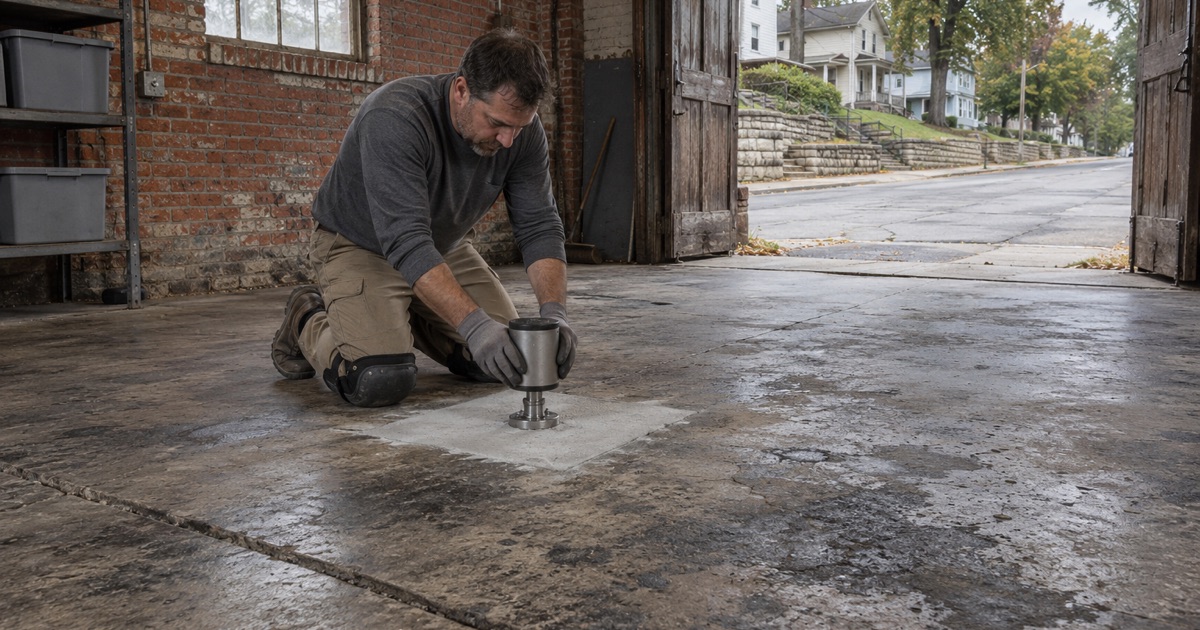
A small metal disc, called a dolly, is bonded to a primed spot on the prepared slab. Once the adhesive has cured, a portable tester grips the dolly and pulls straight up until something lets go, and the gauge records the force at that moment. ASTM D7234 is the test method Sika names for pull-off strength on concrete, and it is the reference we follow when we take the reading. We hold no certification for it and claim none; it is simply a measurement we take on the floor in question.
Reading where it broke
The force number is only half the result. The other half is the face of the dolly once it comes free. If a disc of gray concrete is stuck to it, the bond outlasted the concrete, which is the same 100% concrete failure the data sheets describe.
If the dolly comes away clean with primer on it and bare concrete below, the bond itself failed, which usually points to contamination or a profile that was not open enough. If the break runs through the test adhesive, the pull did not measure the floor at all and has to be repeated. A concrete break at a healthy force is the result we want to see, and a concrete break at a low force tells us the top layer is soft.
What a data sheet number does not promise
The figures on a maker’s sheet were measured on that maker’s test concrete. They describe what the coating can do, not what your slab can do, and no Moline floor inherits them. That is exactly why we test the slab that will actually carry the coating rather than leaning on a published number.
Test Patch First, Whole Floor Second
On an older floor we would rather spend a few days on a test patch than a full week on a floor that turns out to be built on a weak surface. The patch tells us whether the plan works before the whole slab is committed to it.
Prepared the way the full floor will be
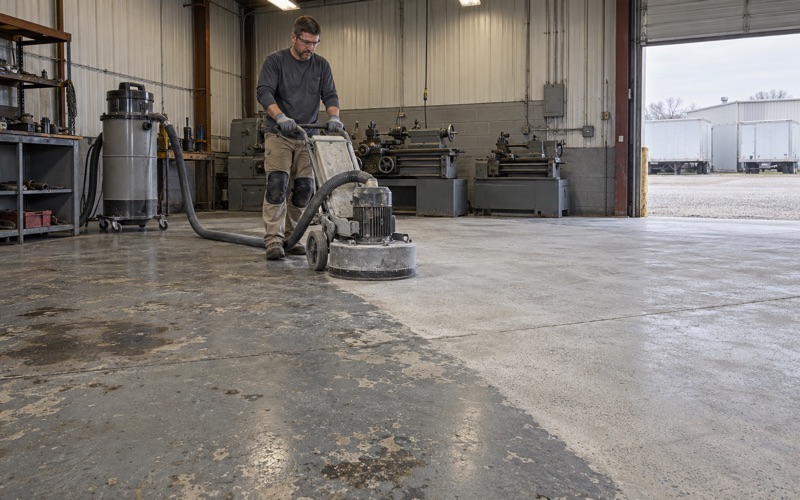
A test patch only means something if it is prepared exactly as the rest of the floor will be. We grind it to the same concrete surface profile the proposal names, capture the dust at the machine with a vacuum rather than washing it toward a floor drain, and apply the same primer the full job will use. The pull-off reading then describes the floor you are buying, not a better-prepared corner of it.
The patch also shows what the grinder finds once the surface is open. Old paint that hid under a coat of dirt, oil that soaked deeper than it looked, and soft spots near a door all tend to surface at this stage, while changing course is still cheap.
Moisture comes along for the reading
Bond and moisture are separate questions, and an old slab has to answer both. Our scope writes in a moisture test, such as a calcium chloride test under ASTM F1869 or relative humidity probes under ASTM F2170, depending on the slab. In an older basement we also read for past water first, checking the floor drain, the sump pit and any white efflorescence on the concrete, because a coating does not stop seepage.
Timing the cure to the slab, not the calendar
Primer and test adhesive cure on the slab’s schedule, not ours. We watch slab temperature and the dew point spread at the surface, and an unheated Moline garage in midwinter is told to wait. The Moline airport station’s 1991 to 2020 normals put the median last spring freeze on April 24 and the median first fall freeze on October 18, which frames the stretch when an unheated space is most likely to cooperate.
When an Old Slab Fails the Test
A poor pull-off result is not the end of the project. It is information, and it usually points to one of a few paths forward.
Weak skin over sound concrete
The most common finding on an old floor is a soft or contaminated top layer sitting on sound concrete below. Grinding or shot blasting deeper, to a heavier profile, often reaches material that tests well, and a second pull on a freshly prepared spot confirms it. That retest is part of the job, not an upsell.
Contamination that keeps coming back
Oil, old coatings and curing compounds can sit below the depth a normal grind reaches. When the dolly comes away clean a second time, we look harder at what is in the concrete and adjust the preparation or the primer before trying again. A floor is not coated over a bond failure we cannot explain.
When repair or replacement comes first
Some slabs are cracked, spalled or crumbling deeper than any grind will fix, and we say so plainly. Patching, crack repair or a replacement pour may have to come before a coating makes sense, and we would rather tell you that now than warranty a floor that was never going to hold.
What the paperwork says on the Illinois side
A Moline job is quoted under Illinois rules. The Illinois architectural coatings rule, 35 Illinois Administrative Code Part 223, reaches anyone who applies a coating in the state and sets a 250 grams per liter limit for floor coatings, so every product we put down here is chosen to meet it. Our warranty terms are explained before the job is sold, and moisture vapor and hydrostatic pressure are the first exclusions we name. A floor coating is never sold as waterproofing, flood protection or radon work.
- 20+ Years in Business
- Moisture Tested Before Pricing
- Free Written Estimates