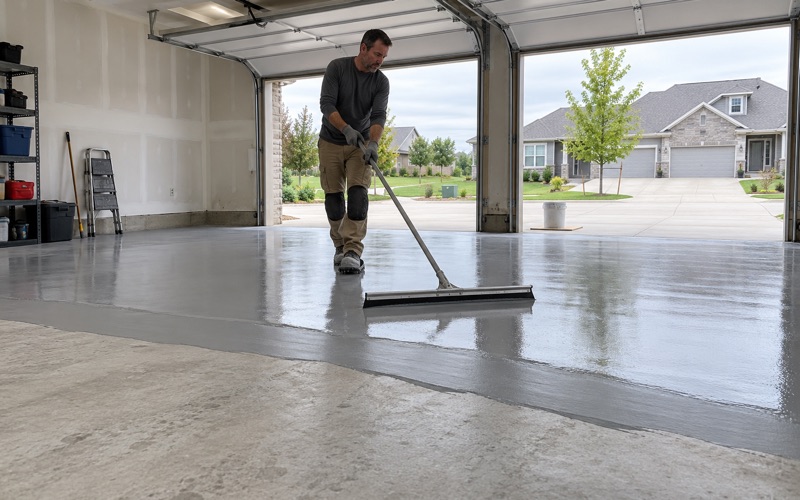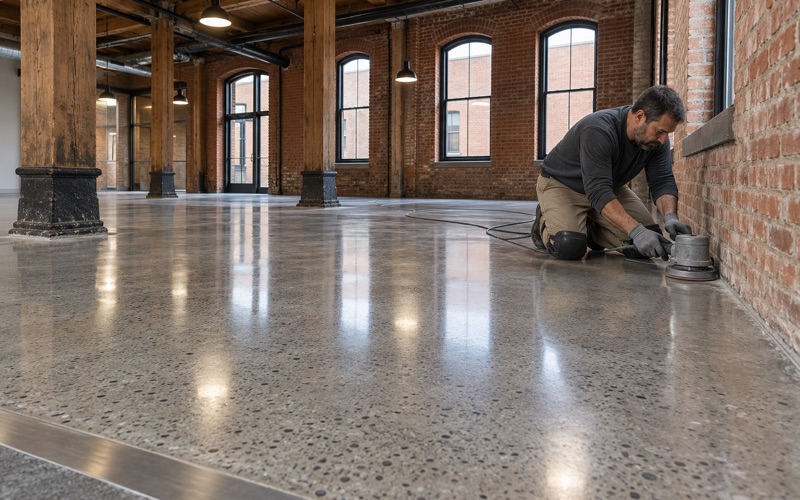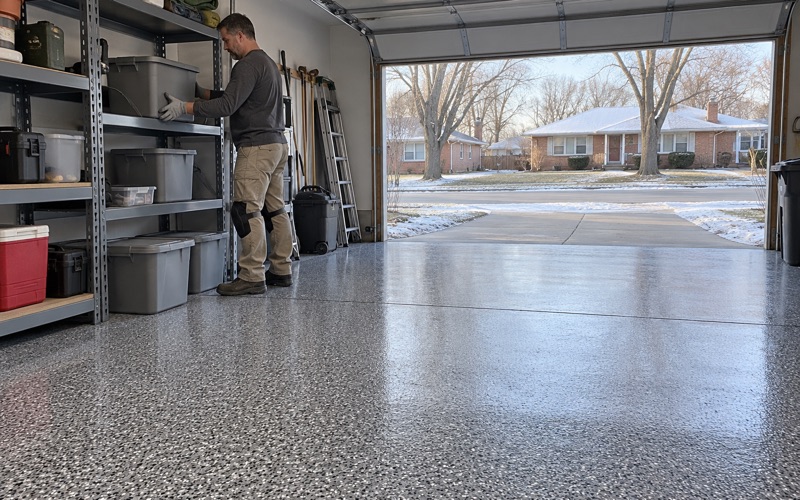
Davenport IA Epoxy Flooring brings more than 20 years of epoxy flooring work to Muscatine, and the plant calls we field here are rarely about a brand-new floor. They are about a coating that has let go in one place while the rest of the building keeps producing. An edge lifts at a joint, a chip opens at a doorway, a pothole wears in where traffic turns, and each of those spots needs an answer before the next shift walks across it.
This page is written for the maintenance managers and plant engineers who make that call. It covers how coatings fail in large production buildings, the walking-surface rule that sets the clock on a repair, how we patch inside a guarded area without stopping a line, and the point where patching should give way to a scheduled re-coat. Our method does not change with the job size: we open concrete mechanically instead of with acid, we test for moisture before a price is final, and our quote states the product, the coat count and the finished thickness in writing.
Six Plants, 2.2 Million Square Feet, and Coatings That Fail in Spots
The scale of manufacturing floor in Muscatine
HNI, the office furniture maker incorporated in 1944, keeps its corporate headquarters in Muscatine. Its annual report for the fiscal year ended January 3, 2026 lists six workplace-furnishings facilities in Muscatine, all owned, totaling 2,211,000 square feet. The company sits at the top of the city’s major-employer list at about 3,100 workers, and its HON brand runs both factories and a distribution center in town.
We have no relationship with HNI, HON or any of their buildings, and we have not seen their floors. We cite those figures because they show what kind of floor work this city holds: assembly halls, warehouses and shipping docks measured in hundreds of thousands of square feet. Any coating spread across that much concrete ages unevenly, and the repair question in a building that size is almost never whether to redo everything at once.
Edges, chips and potholes
A coating that fails in a large plant usually fails at a boundary. Edges lift first along saw-cut joints, at door thresholds and where an old patch meets the original film, because that is where the bond line is thinnest or was never fully keyed into the slab. Chips open where steel parts or tools are dropped, and potholes form in turning lanes where wheels scrub the same few square feet thousands of times a week.
The trouble with each of these is that it grows. A lifted edge gives a wheel or a boot something to catch, and every pass peels a little more film back from the concrete. A chip that reaches bare slab lets dirt and liquids get under the surrounding coating, so a defect the size of a coin can become a strip the length of an aisle if nobody deals with it.
One bad spot is not a failed floor
Before we price anything, we walk the floor and map every crack, spall, lifted edge and earlier repair. That map tells us whether the failures are isolated or whether the coating is losing bond across a whole bay, and those two findings lead to very different scopes. A floor that is sound over most of its area is a patching job; a floor that sounds hollow under a tapping tool from wall to wall is not.
We also say plainly when the concrete itself is the problem. A spall that runs deep into the slab, a cracked section that moves under load, or a joint that has broken down at both edges needs concrete repair before any coating will hold. Patching resin over damaged concrete only puts a fresh surface on top of the same defect.
Looking for epoxy-flooring closer to Clinton? See Epoxy-Flooring Services in Clinton.
Fix It or Fence It: The Walking-Working Surface Rule
What 29 CFR 1910.22 says
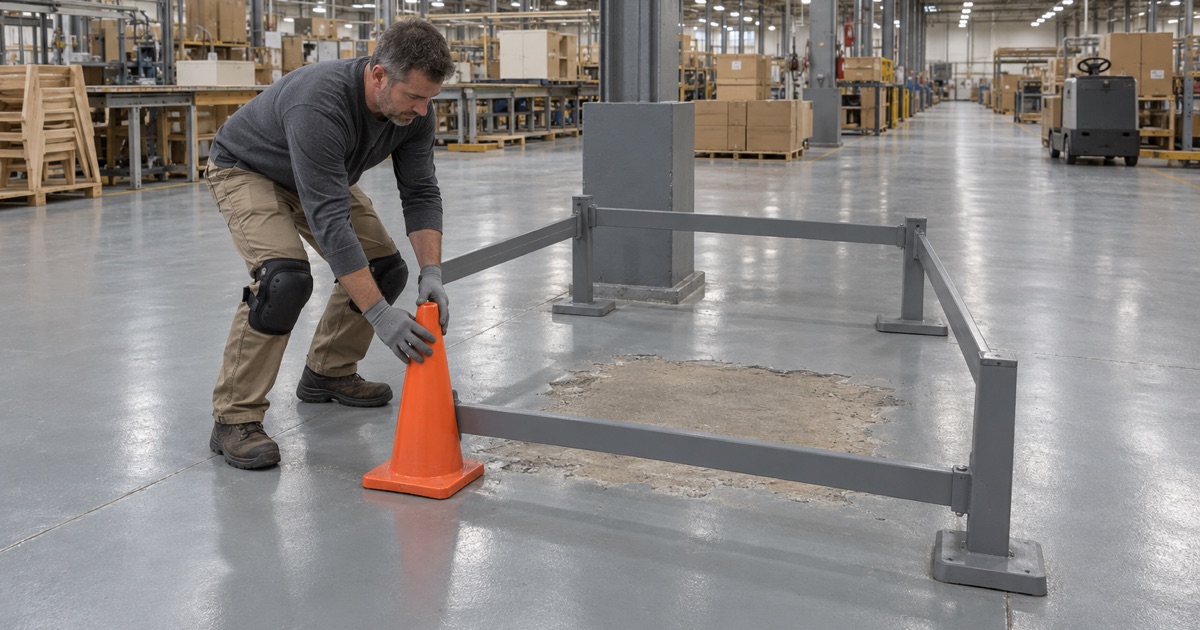
The federal walking-working surface standard requires that floors be inspected regularly and as necessary and maintained in a safe condition. Its next paragraph is the one that shapes floor repair in a working plant: hazardous conditions on a walking-working surface are corrected or repaired before an employee uses that surface again. If the repair cannot be made immediately, the hazard must be guarded to keep employees off it until the work is done.
The same section adds that a qualified person performs or supervises any correction or repair involving the structural integrity of the surface. For coating work that line matters, because a pothole that has gone through the topping and into the slab is no longer only a coating repair. It becomes a concrete question first.
Iowa OSHA enforces the federal text
Iowa runs its own state plan through Iowa OSHA, part of the Iowa Division of Labor Services within the Department of Workforce Development. The plan applies to private sector workplaces across the state and to state and local government employers, and Iowa OSHA has adopted OSHA’s standards. In practice, the federal correct-or-guard sentence is the rule that governs a manufacturing floor in Muscatine.
We are flooring contractors, not safety consultants, and we never present a coating as a way to satisfy an inspector. The employer decides which conditions are hazardous and how an area gets guarded. Our role is to work inside the zone the plant has set up and to give that area back in a condition the plant’s own people can judge.
What the rule does to a repair schedule
Read together, those two requirements turn floor maintenance in a running plant into triage. A lifted edge or a fresh pothole has to be fixed before people use that surface again or fenced off until it is, and nobody wants a barricade sitting in a production lane for weeks. That pushes the work toward small, fast patches done inside guarded zones, with materials picked for a short return to service, while any full re-coat gets planned as a separate project.
Patching Inside a Guarded Zone While the Plant Runs
Opening the damaged area
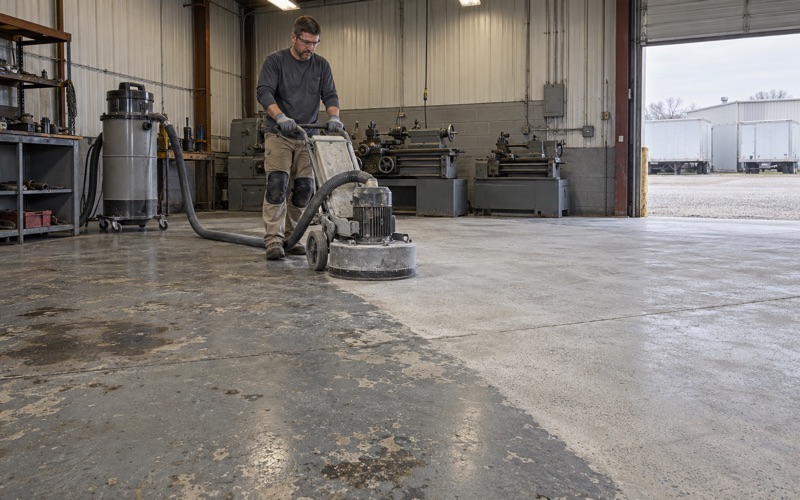
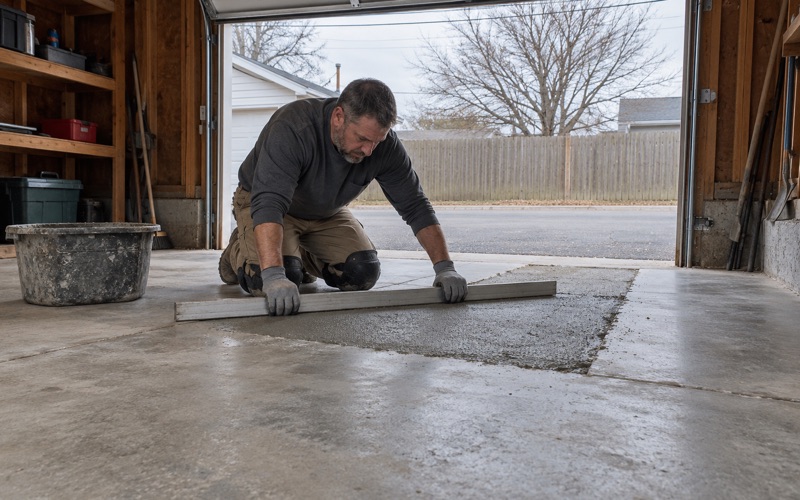
Once the plant has guarded the spot, we cut back to sound coating with a diamond grinder, square off the edges so the patch has a wall to bond against, and grind the exposed concrete to the surface profile written in our proposal, usually an ICRI CSP 2 or CSP 3 for a thin patch. Feathering resin over a ragged, half-attached edge is how a repair fails at its own border a few months later. A clean shoulder on every side keeps traffic from catching the new edge.
Dust is captured at the grinder by a vacuum rather than swept or rinsed. In a building where assembly or finished goods may sit a few yards from the guarded area, airborne concrete dust is a production problem as much as a cleanup one. None of it goes toward a floor drain.
Choosing a patch material for return to service
The right material depends on how long the zone can stay closed. Polyaspartic and fast-set urethane systems can reach foot traffic quickly, which suits a lane that has to reopen by the next shift, but they give the crew very little working time once mixed. A 100% solids epoxy builds thickness well and matches many existing floors, yet it needs longer before wheels can cross it.
We choose by the return-to-service time on the product’s data sheet at the temperature of that slab that night, not by the best case printed on the label. If the guarded area must reopen for a 6:00 a.m. start, the material and the schedule have to agree on that before anyone mixes a batch.
Cure follows the slab, not the clock
Plant slabs near dock doors and outside walls run colder than the air above them, and a slab close to its dew point can sweat under fresh resin. We measure slab temperature and the dew point spread at the surface before a patch goes down, because epoxy laid under those conditions can develop amine blush and a weak bond. When the numbers say wait, we tell the plant to wait, even if that moves the window.
A moisture test is part of the scope on repair work too, using ASTM F2170 in-situ relative humidity probes or ASTM F1869 calcium chloride testing depending on the slab. Coating that lifted because of moisture coming up through the concrete will lift again around a patch unless that cause is addressed first.
When Patching Stops Making Sense and a Re-Coat Starts
Signs the patches are losing
Patching is the right call until the patches start outnumbering the sound floor between them. When new failures keep opening right beside last month’s repairs, when tapping finds hollow coating well beyond the visible damage, or when the old film peels away in sheets instead of chipping, the coating has lost bond across the area. At that point each patch is a short-term fix on a failing system.
We document that change on the same map we drew at the start, so the decision rests on what the floor shows rather than on a sales pitch. If testing points to moisture vapor coming up through the slab or to hydrostatic pressure underneath, we explain that before quoting, because those are the first exclusions in any coating warranty and a new system will not fix them.
Scheduling the full re-coat separately
A re-coat in a building that cannot stop is planned bay by bay around production, using overnight and weekend windows and any planned shutdown the plant already has on the calendar. Large areas are opened with a shot blaster or a ride-on grinder to remove the old coating and reach a uniform profile. Our quote names the product line, the number of coats and the finished thickness for each bay, so the plant can check the finished floor against the paper.
Keeping the patch program and the re-coat as two separate jobs protects both. The guarded-zone repairs keep people safe and production moving this month, and the re-coat can be priced, phased and scheduled without someone rushing it around a hazard that should have been fenced off weeks earlier.
Permits, insurance and registration in Muscatine
Commercial projects in Muscatine fall under the City of Muscatine’s Title 8 building regulations, but the city’s currently adopted code editions could not be confirmed from its posted documents. We ask the city directly before assuming any permit answer for coating work, and we provide the certificate of insurance a permit office or plant safety department asks for.
We also explain the state rules rather than overstate them. Iowa Code chapter 91C sets up contractor registration with the Division of Labor, which is a registration rather than a license, and Iowa has no floor-coating VOC content rule of its own. The federal architectural coatings rule in 40 CFR 59 Subpart D governs the manufacturers who make the products we apply.
- 20+ Years in Business
- Moisture Tested Before Pricing
- Free Written Estimates