
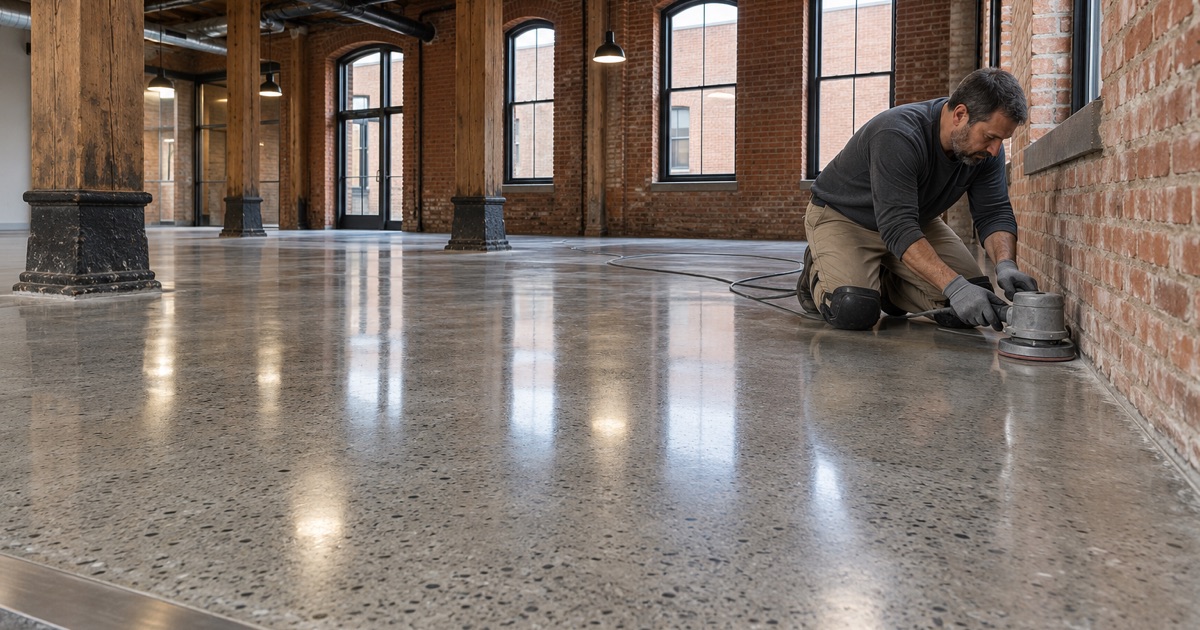
Davenport IA Epoxy Flooring has spent 20+ years grinding and polishing concrete floors in Davenport, IA, serving surrounding cities including Eldridge, Rock Island, Bettendorf, Moline and Milan. Polished concrete is not a coating. It is the slab itself, ground flat with progressively finer diamonds, hardened with a densifier and refined until the surface reflects light, which is why it holds up under forklifts and foot traffic that would wear through a film.
Because the finished floor is the concrete you already have, the result depends on reading the slab before any grinding starts. We map cracks, patches, old adhesive and oil stains, check whether past coatings are still bonded, and show you how much stone the grind is likely to expose. The written proposal states the exposure level, the final grit or sheen, and the products used for densifying and guarding the floor.
That planning matters because the first cuts cannot be undone. Grind too deep and you expose more aggregate than you wanted; stop too shallow and the floor looks blotchy. The sections below explain the choices, where polished concrete works and where a coating is the better call, and how we run the job.
Commercial and Residential Polished Concrete Floors
Warehouses, Plants and Retail Floors
In a warehouse or distribution floor, polished concrete gives a hard, dust-resistant surface that does not peel under pallet jacks and forklift tires. Densifying the top of the slab reduces the concrete dust that unsealed floors shed onto stock and equipment, and the brighter surface reflects overhead light across the aisles. We phase large floors around shifts and racking moves, with overnight and weekend windows when the building cannot stop.
Retail stores, car dealerships and showrooms choose polished concrete for a clean, modern look that cleans up with an auto scrubber. Along the I-80 corridor and the Eastern Iowa Industrial Center, plants often combine polished aisles with coated areas where chemicals or washdown would stain bare concrete.
Offices, Clinics and Restaurants Front of House
Offices, clinics and dining rooms use polished concrete where they want a floor that looks finished but is simpler to maintain than tile or carpet. A medium sheen with a stain guard handles daily foot traffic and rolling chairs without the grout lines that trap dirt. Dyes can add a warm or cool tone, and saw-cut patterns can break up a large open space.
Commercial projects carry the certificate of insurance the permit office asks for. We explain the state and city registration rules that apply to the job rather than quoting a credential on a sales page.
Basements, Living Spaces and Home Shops
In homes, polished concrete suits finished basements, lower-level family rooms and modern living spaces built on a slab. It has no film for moisture vapor to push loose, which makes it a practical choice where a coating might struggle. A home shop or garage can also be polished, though road salt and hot tires make a coated system the more common choice for parked cars.
Old basement slabs in Davenport often carry paint, tile mastic and years of patches. All of that has to be ground off first, and patches will show through the polish, so we talk through the look honestly before you commit.
How a Polished Concrete Floor Is Built
Grind Depth and Aggregate Exposure
The first metal-bond diamonds decide how much of the stone in the concrete shows. A cream finish barely touches the surface, a salt-and-pepper finish exposes fine sand and small aggregate, and a full exposure cuts deep enough to show larger stones across the floor. Each level costs more labor and changes the look, and the choice has to be made at the start.
Slabs are not uniform, so exposure can vary across a floor where the original pour was troweled differently. We grind a small test area when the look matters, so you see your own concrete rather than a sample board.
Lithium Silicate Densifier
After the coarse grinding, a lithium silicate densifier is applied to react with the concrete and harden the surface. That hardened layer is what lets the floor take a high polish and resist abrasion and dusting. Lithium densifiers are applied in thin coats and do not leave a film that can peel later.
On soft or older slabs, the densifier makes a visible difference in how well the floor polishes. It is one reason older concrete can still produce a durable floor when it is prepared correctly.
Polish Level, Dyes and Stain Guard
Resin-bond diamonds then refine the surface in steps, from a low-sheen satin to a high-gloss finish that reflects overhead lights. Dyes can be applied between passes for color, and a penetrating stain guard goes on at the end to slow down oil, coffee and other spills. The guard does not make the floor stain-proof, so quick cleanup still matters.
Higher gloss looks impressive in a showroom but shows scratches and dust sooner. For warehouses and entryways that see snowmelt, a medium polish is usually the better balance.
Our Step-by-Step Polished Concrete Floors Process
Step 1: Slab Assessment and Test Grind
We check hardness, cracks, old coatings, oil saturation and existing patches, then grind a test area if the finish is uncertain. The proposal names the exposure level, the final sheen, the densifier and the guard. Any slab condition that will show in the finished floor is pointed out before you sign.
Step 2: Coating Removal and Coarse Grinding
Old paint, epoxy, carpet glue and tile mastic are ground off, with dust captured at the machine rather than swept or rinsed toward a drain. Coarse metal-bond diamonds then flatten the surface and expose the agreed level of aggregate. Cracks and joints are filled with a color-matched filler at this stage if you want them softened.
Step 3: Densify and Refine
The densifier goes on after the coarse passes and is allowed to react before resin-bond diamonds take over. Each finer grit removes the scratches from the one before. Skipping steps leaves visible swirl marks, so we work through the sequence even when it takes another pass.
Step 4: Guard, Burnish and Walk-Through
The stain guard is applied and burnished into the surface, then the floor is cleaned and inspected under the room’s own lighting. We walk the floor with you, compare it to the proposal and leave care instructions suited to the traffic it will see.
When a Coating Is the Better Choice
Chemical Spills, Washdown and Wet Areas
Polished concrete is still bare concrete, so acids, battery fluid and harsh cleaners can etch it. Food plants, wash bays and battery rooms are usually better served by an epoxy or urethane cement system that seals the slab. We will recommend the system that fits the use, even if it is not the one you asked about first.
Damaged or Heavily Patched Slabs
If a slab has many patches, large repairs or deep oil saturation, a polish will show all of it. A coating can cover that history and still give you a durable, uniform floor. We show you the trade-off with your own slab before either option is priced.
- 20+ Years in Business
- Moisture Tested Before Pricing
- Free Written Estimates