Davenport IA Epoxy Flooring has installed polyaspartic floor coatings for 20+ years in Davenport, IA, serving surrounding cities including Eldridge, Rock Island, Bettendorf, Moline and Milan. Polyaspartic is a fast-curing coating related to polyurea, and it has become our most common topcoat for garages and commercial floors because it stays clear in sunlight, resists abrasion and lets a space go back into use far sooner than a standard epoxy.
Speed is only an advantage when the prep is right. Polyaspartic sets quickly, so it gives an installer no time to fix a poorly prepared slab once it is down. Every floor is diamond ground or shot blasted to a stated surface profile, cracks and spalls are filled, and a moisture test is in the scope before we give you a final price. The proposal names the product line, the number of coats and the finished thickness.
We use polyaspartic in two ways: as a full system for floors that need to return to service quickly, and as a topcoat over a 100% solids epoxy body coat where thickness and cost matter. The sections below explain the difference, where each works best, and the trade-offs a straight sales pitch tends to leave out.
What a Polyaspartic Floor Coating Is
Polyaspartic Compared With Epoxy
Epoxy cures slowly, which gives it a long working time and strong adhesion as a base coat, but it can yellow in sunlight and needs a day or more before vehicles return. Polyaspartic is an aliphatic polyurea variant that cures in a fraction of the time and resists both UV and abrasion. It is also more flexible, which helps it ride through the small temperature swings a garage slab sees across a day.
Those properties make the two products complementary rather than competing. An epoxy body coat builds thickness and fills the profile, and a polyaspartic topcoat protects it from sunlight, tires and chemicals.
UV Stability for Garages and Storefronts
Sunlight through an open garage door, a storefront window or a showroom skylight slowly ambers many epoxy floors. Polyaspartic topcoats do not yellow the same way, so colored flake blends and solid grays keep their tone. That makes it the usual choice for west-facing garages and retail floors with large glass fronts.
The clear topcoat also gives a consistent sheen across the floor. We offer gloss and satin options, and satin hides tire marks and dust better in daily use.
Fast Cure and Return to Service
The quick cure is what makes one-day and next-day floors possible. A homeowner can often park sooner than with an all-epoxy system, and a business can coat a showroom or service counter area over a weekend. Restaurants, clinics and shops that cannot close for several days benefit most.
That speed does have limits. Slab repairs, coating removal and moisture-mitigation primers each add time, and we plan the schedule around what the slab actually needs.
Where Polyaspartic Coatings Fit, Home and Business
Residential Garages and Salt Season
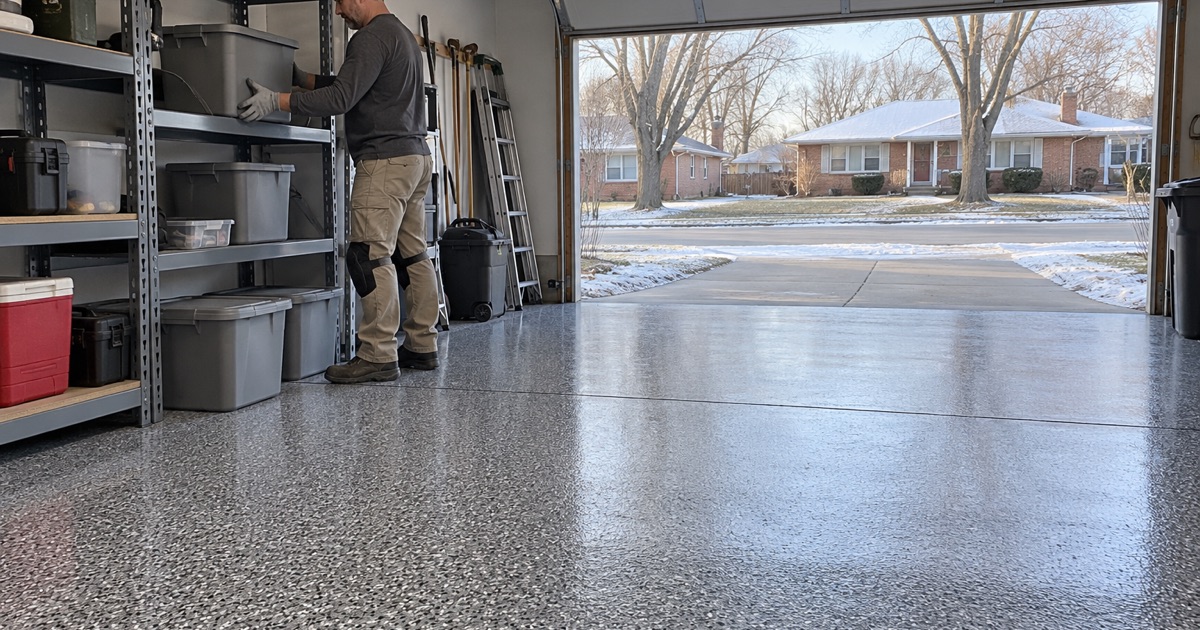
In a garage, a polyaspartic topcoat over flake gives a hard, chemical-resistant surface that shrugs off the calcium chloride brine and rock salt carried in on tires all winter. Salt film and slush stay on top where they rinse away, rather than soaking into the slab and causing freeze-thaw scaling. Its resistance to hot tire pickup comes from both the coating’s toughness and the ground base it is bonded to.
We can add a fine anti-slip aggregate to the topcoat for garages that see a lot of meltwater. It keeps footing safer without making the floor hard to squeegee.
Commercial Entries, Retail and Service Areas
Retail floors, building entries, auto service areas and kennels use polyaspartic for its quick turnaround and abrasion resistance. A store can be coated after closing and open the next day, and a vet clinic or kennel gets a seamless floor that handles frequent cleaning. We phase larger areas so part of the space stays open while another section cures. Commercial projects carry a certificate of insurance for the permit office, and Illinois-side jobs are quoted against Illinois Part 223 VOC limits for floor coatings.
Extending the Season in Cold Weather
Davenport averages 135.8 nights a year at or below 32 degrees, which narrows the window for coating unheated garages with standard epoxy. Polyaspartic tolerates lower slab temperatures, which can open a few more weeks in spring and fall. It still needs the slab above its minimum and a safe dew point spread, so deep-winter work in an unheated space is still something we advise against.
When readings fall outside the product limits, we reschedule rather than push ahead. A coating that cures cold can stay soft or blush on the surface.
Trade-Offs to Know Before Choosing Polyaspartic
Short Pot Life and Installer Skill
Polyaspartic can begin to set within minutes of mixing, so the crew works in small batches with a fixed rhythm. Mistakes such as roller marks, missed edges or uneven flake cover are hard to fix once the coating sets. That is why surface prep and crew experience matter more with this product than with slow-curing epoxy.
The product’s speed is also why we do not recommend it for metallic or other decorative effects that need time to move in the wet resin. Those systems use epoxy for the decorative layer.
Humidity, Dew Point and Surface Moisture
Polyaspartic reacts with moisture in the air, and high humidity speeds up its cure even further. If the slab surface is too close to the dew point, condensation can disrupt the bond or leave a hazy finish. We measure the slab temperature and dew point spread at the surface before each coat and adjust the schedule when the numbers call for it.
Moisture coming up through the slab is a separate issue. ASTM F1869 or ASTM F2170 testing tells us whether a moisture-mitigation primer is needed under the system.
Full Polyaspartic or Epoxy-Base Hybrid
A full polyaspartic system gives the fastest turnaround, but building thickness with it costs more. An epoxy-base hybrid uses 100% solids epoxy for the primer or body coat and polyaspartic for the topcoat, giving thickness and adhesion at a lower cost with the same UV and wear surface. We explain both options in the proposal so you can weigh speed against price.
Our Step-by-Step Polyaspartic Floor Coating Process
Step 1: Slab Test and Proposal
We test moisture, map cracks and old coatings, and confirm the system and schedule. The proposal names the surface profile, primer, coat count and finished thickness, and it lists what the coating warranty excludes, starting with moisture vapor transmission and hydrostatic pressure.
Step 2: Grinding and Repairs
The slab is diamond ground with dust captured at the machine, then cracks and spalls are filled with fast-setting repair material. The surface is vacuumed clean, because any dust left behind is trapped forever under a quick-curing coat.
Step 3: Base Coat and Broadcast
The primer and base coat go down in small batches, with flake or quartz broadcast while the coat is wet if the system calls for it. After cure, loose broadcast is scraped and vacuumed off.
Step 4: Topcoat and Final Walk-Through
The polyaspartic topcoat is rolled on, and we walk the floor with you once it is ready for foot traffic. You get a time to park or reopen and care instructions suited to the space.
- 20+ Years in Business
- Moisture Tested Before Pricing
- Free Written Estimates