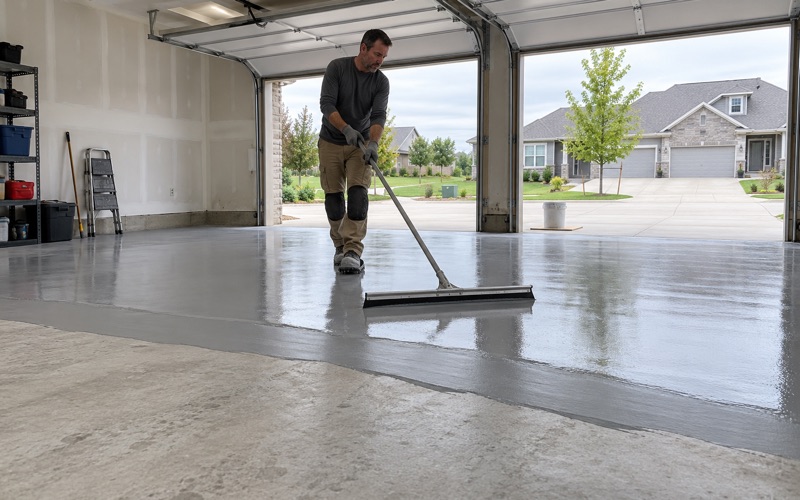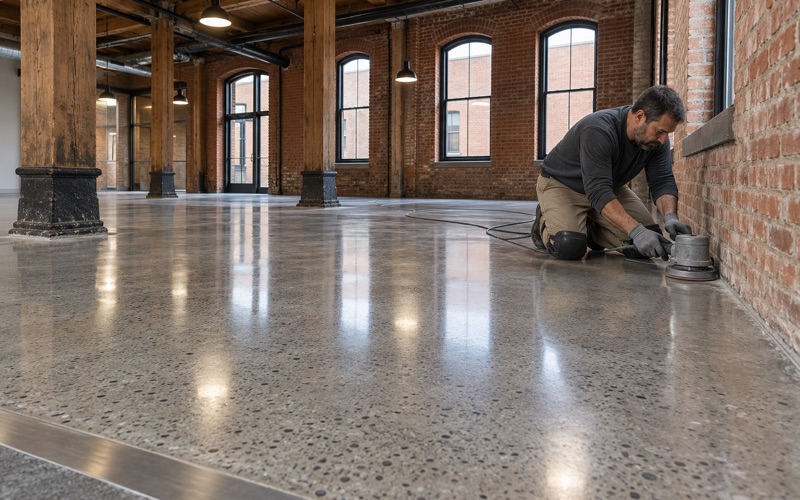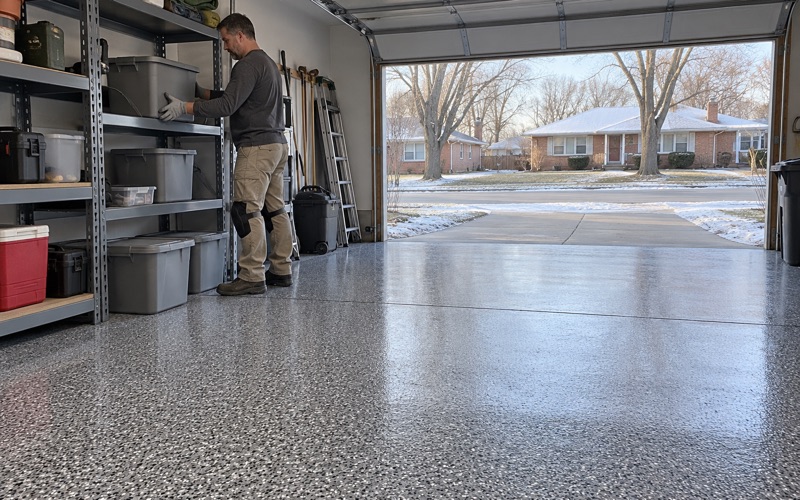
Davenport IA Epoxy Flooring handles epoxy flooring in Rock Island, Illinois, with more than 20 years spent grinding, testing and coating concrete for garages, shops and commercial buildings that cannot simply lock their doors for a week. On a commercial job here, the first question an owner asks us is rarely about color. It is how long each part of the floor has to stay roped off, and whether the business can keep running around the work.
That answer is not a guess and it is not a sales promise. It comes from the coating maker’s own cure table, read at the temperature of the slab we are actually standing on, and it changes with the product we pick. A floor that has to stay open is planned in sections, and each section gets a closing time it can live with.
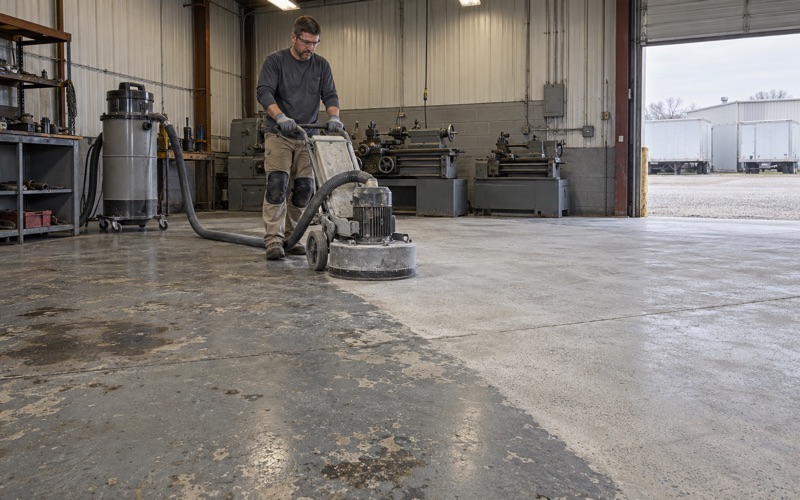
The preparation does not shrink because the schedule is tight. Every section is opened with a diamond grinder or a shot blaster rather than an acid etch, and the proposal names the surface profile we are grinding to. A moisture test is written into the scope before the price is final, and the quote names the product line, the number of coats and the finished thickness, so a manager can check the finished floor against the paper.
A Rock Island Building That Never Closes
Bally’s Quad Cities and the floor that is always in use
Rock Island is the Rock Island County seat, and its clearest example of a building that never shuts is Bally’s Quad Cities Casino and Hotel. The land-based complex near Interstate 280 and Illinois 92 opened on December 1, 2008 as Jumer’s Casino and Hotel, and the Enjoy Illinois listing describes it as open 24 hours, 7 days a week. It carries a 205-room hotel and an event center with meeting rooms for up to 500 people.
We have never worked at Bally’s, and nothing we have read describes its floors or any back-of-house space there. It matters to this page for a simpler reason: a property that is open 24 hours never hands a flooring crew a closed building. Any Rock Island hotel, plant, warehouse or service operation that runs through the night faces the same arithmetic on a smaller scale.
How the coating makers say to divide the work
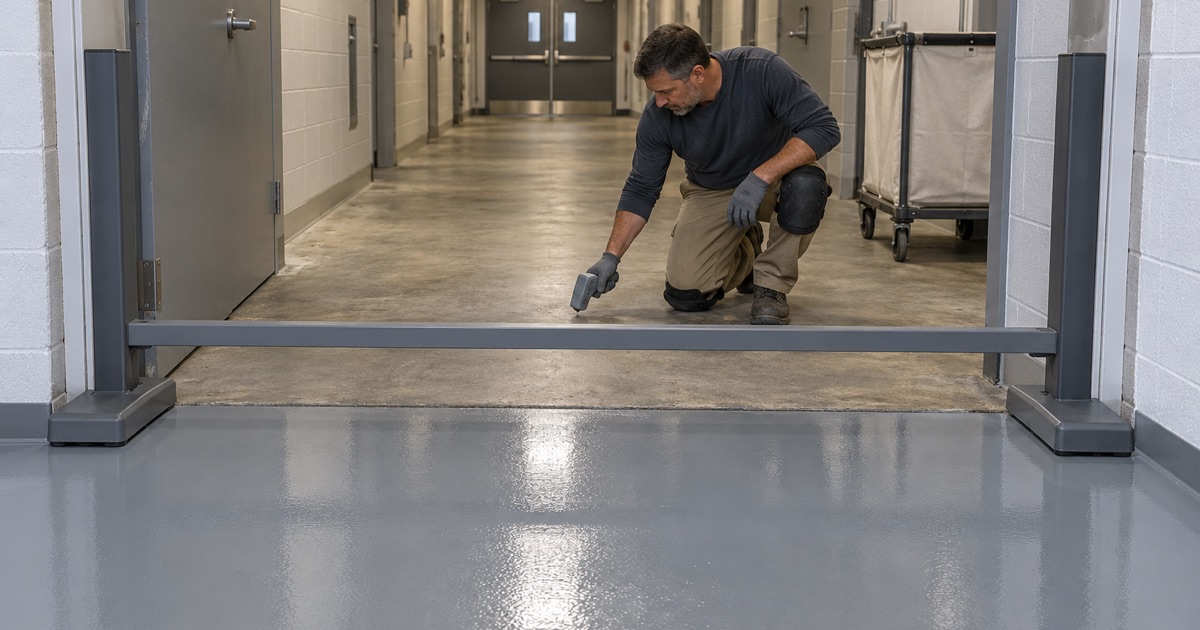
Coating manufacturers write their instructions with this problem in mind. Sika’s data sheet for Sikafloor-315 N says the floor area should be divided into sections that can be completed in one application sequence. It adds that sections should be divided at expansion joints or doorways when possible, with the end of each section taped off to leave a straight, clean edge for the next one.
That guidance turns a floor that cannot close into a floor that closes one section at a time. A joint or a doorway gives the coating a natural stopping line, and it gives the people using the building a clear boundary between the space they can walk on and the space they cannot.
What sectioning looks like on our jobs
Before we quote, we map cracks, spalls and old coatings across the whole floor, then draw the section lines along the joints and doorways that already exist. Each section is ground with the dust captured at the machine by a vacuum, never rinsed toward a floor drain. Then it is tested, coated and fenced off until the maker’s clock says it can carry traffic again.
Plant, shop and warehouse floors are phased around shifts and production, and we offer overnight and weekend windows when the work cannot stop. The section plan is part of the proposal, so the owner knows in advance which area closes when and for roughly how long.
Looking for epoxy-flooring closer to Bettendorf? See Bettendorf Epoxy-Flooring.
Reading a Maker’s Traffic Clock
Sikafloor-315 N: hours measured against temperature
A cure table is the most useful page on any coating data sheet, and Sika’s table for Sikafloor-315 N shows why. At 68 degrees F, ambient and substrate, the floor takes foot traffic after 24 hours, light traffic after 2 days and reaches full cure in 7 days. At 86 degrees F those numbers drop to 18 hours, 36 hours and 5 days.
The same sheet sets the recoat window between coats at 12 to 48 hours at 68 degrees F, and 8 to 24 hours at 86 degrees F. Miss that window and the next coat no longer bonds the way the maker intends, so the recoat clock has to fit inside the section’s closing time as well.
APF Polyaspartic 7500: light traffic in about 4 hours
A polyaspartic coating runs on a very different clock. APF’s data sheet for Polyaspartic 7500 lists, at 77 degrees F, a working time of about 10 to 15 minutes, dry to touch in about 2 to 3 hours, light traffic in about 4 hours and vehicle traffic in about 24 hours. The maker states that it cures quickly and can be fully returned to service within 24 hours.
The short working time cuts both ways. Material has to be mixed in small batches and placed quickly, and if the 24-hour recoat window is exceeded, APF calls for the surface to be abraded with 100-grit before another coat goes on.
Foot traffic, light traffic and full cure are separate gates
Owners often hear one number and assume it covers everything. It does not. Foot traffic means people walking carefully across the section, light traffic means carts and normal use, and full cure is the point at which the coating reaches the hardness and chemical resistance the maker rates it for.
A section that reopens to foot traffic is not yet ready for a pallet jack, a cleaning machine or a spilled solvent. When we hand a section back, we tell the manager which of those gates it has passed and when the next one arrives, in writing, so nobody reopens to forklifts on a foot-traffic number.
Why a Cool Back-of-House Slab Doubles the Wait
Twice the hours on the same product
The figures above are maker figures at stated temperatures, and the temperature is where a schedule gets stretched. On Sikafloor-315 N, foot traffic arrives in 24 hours at 68 degrees F but takes 48 hours at 50 degrees F. Light traffic moves from 2 days to 3 days, and full cure from 7 days to 10.
The recoat window moves too, to 18 to 72 hours at 50 degrees F. Sika sets 50 degrees F as the minimum ambient and substrate temperature and 85 degrees F as the maximum, and it warns that workability drops and cure slows outside that range.
Polyaspartic slows down as well
A faster chemistry does not escape temperature. APF says lower temperatures and higher humidity increase cure time, and it lists an application range of 50 to 85 degrees F for both the surface and the air, with the product able to cure down to 40 degrees F. The 4-hour light traffic figure belongs to 77 degrees F, not to a cool room.
So a back-of-house corridor, a loading area or a storage room that runs well below the lobby temperature should be expected to run at the slow end of any table. We would rather tell an owner that plainly before the work than explain a delay after it.
We measure the slab, not the thermostat
The concrete can sit several degrees cooler than the air above it, especially in a space with an outside wall or a slab on grade. Our cure schedules follow the measured slab temperature rather than the calendar, and the section plan is written around that reading.
If a section measures near the bottom of a product’s range, we either pick a different product for that area or lengthen its closure on paper before anyone signs. A schedule built on the hallway thermostat is the one most likely to reopen a floor too early.
Choosing the System by the Hours a Section Can Stay Closed
When a section can close for days
Where an area can be fenced off for several days, a 100% solids epoxy body coat gives a thick, durable build, and a quartz aggregate broadcast or a vinyl flake broadcast adds texture and grip. The longer clock is the price of that build, and it is usually affordable in a storage room, a shop bay or a space that sits empty between events.
When a section gets one overnight window
Where a section has only a single overnight or weekend window, a polyaspartic topcoat or a full polyaspartic system is often the better fit, because its maker rates it for light traffic in about 4 hours at 77 degrees F. That is a maker figure, not a guarantee of same-day reopening, and a cool slab moves it. Grinding, the moisture test and crack repair still take their own time before any coating goes down.
Sometimes the honest answer is a hybrid: an epoxy base in the sections that can close longer and a faster-cure system in the doorways and corridors that cannot. We explain which choice fits which area, and why, before a price is final.
What goes in writing before the first section closes
Every proposal names the product line, coats and finished thickness, the section lines and the maker’s traffic times at the temperature we measured. It also explains what the coating warranty excludes before the job is sold, and moisture and hydrostatic pressure are the first exclusions we name. If the cracks and old coatings we mapped show a slab that needs repair or replacement first, we say so.
Rock Island jobs are quoted under the Illinois Part 223 VOC limits for floor coatings, which bind whoever applies them in the state. The City of Rock Island runs its own annual contractor registration that expires on December 31, and the city Inspections Division enforces its adopted building codes. On commercial projects we carry the certificate of insurance a permit office asks for and walk owners through those registration rules rather than claiming a credential we do not hold.
- 20+ Years in Business
- Moisture Tested Before Pricing
- Free Written Estimates