Davenport IA Epoxy Flooring has spent more than 20 years installing epoxy flooring in Silvis and the rest of the Illinois side of the Quad Cities, and some of the most instructive jobs are small rooms in old buildings. A storefront slab that has carried decades of foot traffic, fixtures and remodels rarely arrives ready for a coating. It arrives with a history of patched trenches, leftover adhesive, hairline cracks and the occasional open joint.
On that kind of floor we find out what the concrete is doing before anyone picks a color. Every crack, spall and old coating gets mapped, a moisture test goes into the written scope before the price is final, and the surface is opened with a diamond grinder or a shot blaster rather than an acid etch. When a slab needs repair before it should be coated, the proposal says so in plain words.
This page is for owners and tenants of small commercial spaces, studios in particular, where a floor has to do more than look tidy on opening day. It has to stay smooth, sealed and easy to wash for years of daily cleaning.
Storefront Studios on 1st Avenue in Silvis, Illinois
Silvis is a Rock Island County city in the Quad Cities, sitting next to East Moline and Moline. Its downtown keeps small shops in older storefronts along 1st Avenue, the stretch that also carries Illinois 84 and Illinois 92 through town. The Tat Spot, a tattoo studio at 817 1st Ave, works by appointment out of a suite in that commercial area, which is a fair picture of the kind of space this page is about.
Those buildings were not poured with a studio in mind. Their slabs have been retail floors, office floors and storage floors, and each tenant left something behind: tile mastic, paint, a filled trench where plumbing moved, a crack that opened and was never touched. None of that is unusual, but all of it matters once a room has to meet a written standard for its floor.
What the Illinois body-art premises rule asks of a floor
The Illinois Tattoo and Body Piercing Establishment Code covers the premises, not just the work. Title 77 of the Illinois Administrative Code, Section 797.1100, says all walls, floors and procedure surfaces of a body art establishment shall be smooth, free of open holes and cracks, and washable. The same section says walls, floors and ceilings shall be in good repair and maintained in a clean condition.
Read as a floor specification, that is three separate demands. Smooth is about the surface texture, washable is about what the finish can take from water and cleaners, and free of open holes and cracks is about the concrete underneath. A coating can deliver the first two on its own, but it cannot honestly deliver the third over a slab that is still broken.
What the rule does not say
The rule describes the condition of the floor, not a product. No state agency approves a particular epoxy for a studio, and we never present a coating as a guarantee of passing an inspection. What we can do is build a floor whose condition matches the words in the rule, and explain each step so the owner can show what was done.
Looking for epoxy-flooring closer to East Moline? See Epoxy-Flooring Services in East Moline.
Why the Cracks Come First on an Old Storefront Slab
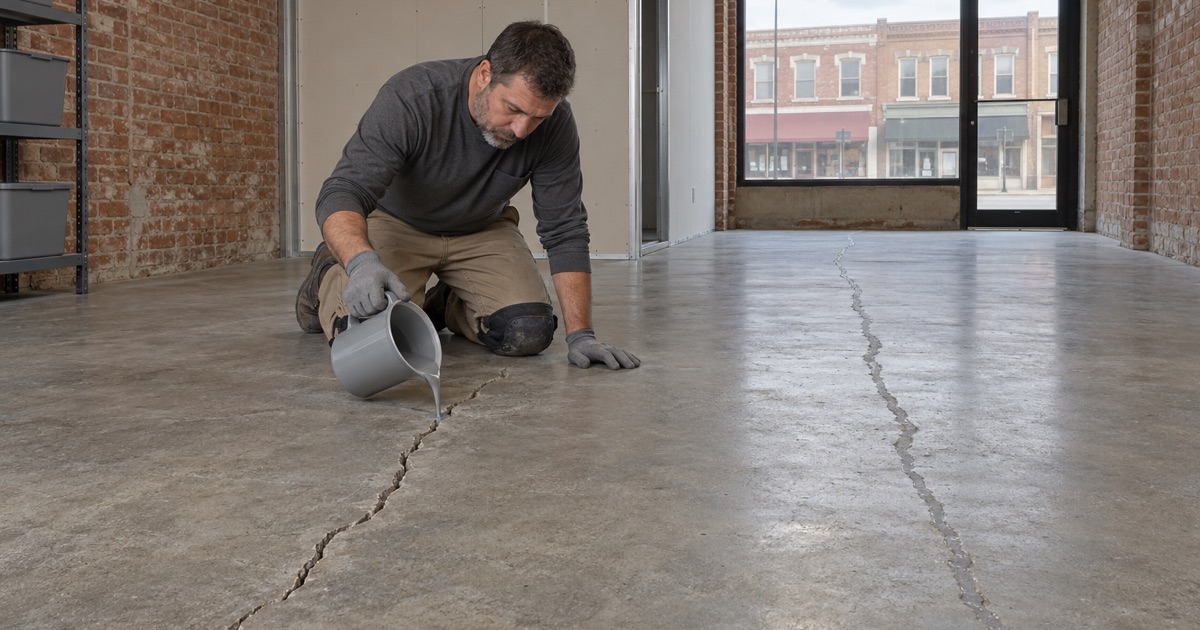
A thin coating rolled over an open crack does not close it. The resin bridges the gap for a while, then the crack telegraphs through as a line, a dip or a split once the slab moves with the seasons. On a floor that has to stay free of open holes and cracks, that is the wrong place to save a day of labor.
Mapping before the quote
We walk the room before pricing it and mark every crack, spall, patch and loose topping. Cracks are sorted by width and by whether they look active or dormant, and saw cuts or construction joints are noted separately because they behave differently. That map becomes part of the proposal, so the repair work is priced in the open rather than discovered halfway through.
Moisture is checked in the same visit. Depending on the slab, that means ASTM F2170 in-situ relative humidity probes or an ASTM F1869 calcium chloride test, and the result decides whether a moisture-mitigation primer belongs in the system. An old storefront floor that sits on grade with no vapor retarder underneath is a common case, and finding that out before the coating is chosen avoids blistering later.
Opening, cleaning and filling
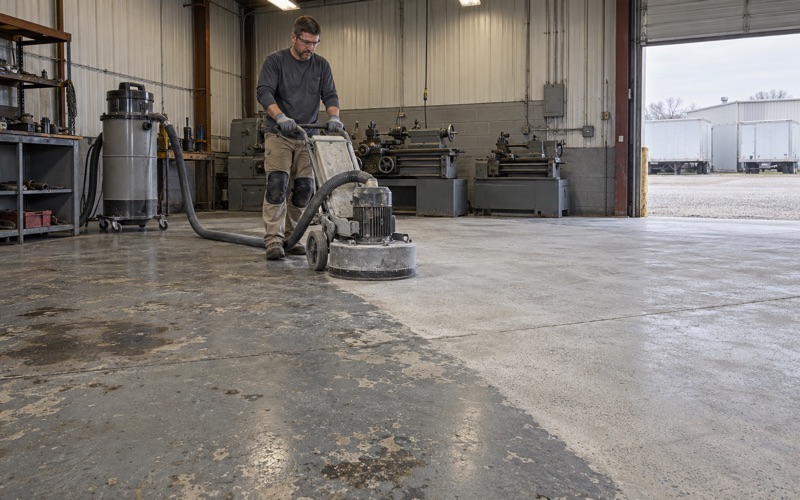
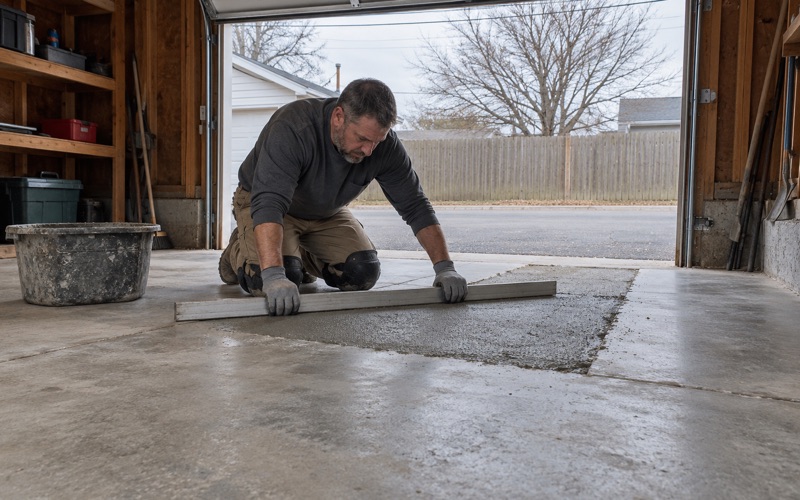
Grinding comes first, because it removes the old adhesive and paint and gives the repair materials a clean profile to grip. Cracks are then chased open with a crack chaser or a small diamond blade, vacuumed out and filled. Dormant cracks get a rigid epoxy or polyurea filler ground flush with the slab, while working joints get a flexible filler sized to the joint so the floor can still move without tearing the finish.
Spalls and holes are rebuilt with a repair mortar and ground level. Grinding dust is pulled into a vacuum at the machine instead of being rinsed toward a drain, which matters in a shared building where the next suite may be open for business on the other side of the wall.
When repair is not enough
Occasionally a slab is too far gone, with heaved sections, a hollow-sounding topping or cracks that keep opening. In that case we say the floor needs replacement or major concrete work before a coating makes sense. A smooth finish over a failing slab would look right for a season and then fail the same rule it was meant to meet.
Floor-to-Ceiling Separation When Shops Share a Building
Section 797.1100 also requires a body art establishment to be completely separated, by solid partitions or by walls running floor to ceiling, from rooms used for living space, food preparation and hair salons, among other activities. That is a wall question, not a coating question. It still shapes the floor job, because a new partition and a new floor have to meet somewhere.
Shared storefront buildings are ordinary in downtown Silvis. KWQC reported in June 2025 on a barber shop and tanning salon sharing one downtown building, which shows how several small businesses can sit under one roof. When a studio moves into a building like that, the separation the rule asks for is often new construction.
Sequencing the wall and the floor
If a partition is going in, we work out with the owner whether the floor is coated before or after the framing. Coating first gives one continuous surface that the wall sits on, while coating after means the finish has to be terminated cleanly at the base. Either way, the edge along the new wall should not be left as an open seam where water and dirt collect.
We do not design or build partitions, and we tell owners to confirm the wall details with whoever is doing that work. Our part is making sure the floor on the studio side reaches the wall as one smooth, sealed surface.
Light and color in the procedure area
The same section sets artificial light of at least 20 foot candles. A lighter floor color reflects more of that light back into the room, which many artists appreciate at the station. It is a comfort choice, not a substitute for the fixtures the rule actually counts.
From Crack Repair to a Sealed, Washable Finish
Once the slab is sound, the system is chosen for a room that gets washed constantly. For most studios and small storefront spaces that means a 100% solids epoxy body coat over the repaired, ground slab, followed by a polyaspartic or urethane topcoat that holds up to daily cleaners. The quote names the product line, the number of coats and the finished thickness, so the completed floor can be checked against the paper.
Texture that stays washable
A washable floor and a slip-resistant floor pull in slightly different directions. Heavy quartz broadcast grips well but traps more dirt, while a fully smooth gloss cleans easily and can feel slick when wet. In a procedure room we usually keep the texture fine, enough to steady a rolling stool and a walking client without giving grime a place to sit.
Vinyl flake can work in a front waiting area where appearance matters more, but in the procedure area we lean toward a tight, uniform surface. The goal is a floor that reads as smooth to the hand and the mop, with no pinholes, no ridges at repairs and no gaps along the base.
Cure, odor and Illinois coating rules
Illinois-side jobs are quoted under Illinois rules, and the coatings we use on a Silvis floor are selected to meet Part 223 of the state’s air pollution rules for floor coatings. Cure times follow the slab temperature and the dew point spread at the surface rather than the calendar, because an unheated storefront in midwinter cures far more slowly than the label suggests. Lower-odor products are available when a neighboring business shares the air, and we offer them as a comfort choice.
Scheduling around appointments
Studios that work by appointment can usually block out a few days, but rarely a week. We plan grinding and crack repair for one window and coating for the next, using evenings and weekends where the building allows, and we give a clear time for light foot traffic and for moving furniture back. That way the room reopens with a floor that is sealed, smooth and ready for its first wash.
- 20+ Years in Business
- Moisture Tested Before Pricing
- Free Written Estimates